Monthly Archives: December 2019

Cigarette Taxes and Cigarette Smuggling by State, 2017

Key Findings

  • Excessive tax rates on cigarettes approach de facto prohibition in some states, inducing black and gray market movement of tobacco products into high-tax states from low-tax states or foreign sources.
  • New York has the highest inbound smuggling activity, with an estimated 55.4 percent of cigarettes consumed in the state deriving from smuggled sources in 2017. New York is followed by California (44.6 percent of consumption smuggled), Washington (42.8 percent), New Mexico (40.8 percent), and Minnesota (34.6 percent).
  • New Hampshire has the highest level of outbound smuggling at 65 percent of consumption, likely due to its relatively low tax rates and proximity to high-tax states in the northeastern United States. Following New Hampshire is Delaware (40.6 percent outbound smuggling), Idaho (26.8 percent), Virginia (24.2 percent), and Wyoming (22.4 percent).
  • Pennsylvania, following a cigarette tax increase from $1.60 to $2.60 in early 2016, has seen a significant increase in smuggling into the state.
  • Cigarette tax rates increased in 37 states and the District of Columbia between 2006 and 2017.
  • Lawmakers interested in taxing and regulating electronic cigarettes should understand the policy trade-offs related to high taxation or bans of nicotine products. With distribution networks already well-developed, criminal gangs are poised to expand into vapor products.

Tobacco Tax Differentials across States Cause Significant Smuggling

The crafting of tax policy can never be divorced from an understanding of the law of unintended consequences, but it is too often disregarded or misunderstood in political debate, and sometimes policies, however well-intentioned, have unintended consequences that outweigh their benefits.

One notable consequence of high state cigarette excise tax rates has been increased smuggling as people procure discounted packs from low-tax states and sell them in high-tax states. Growing cigarette tax differentials have made cigarette smuggling both a national problem and, in some cases, a lucrative criminal enterprise.

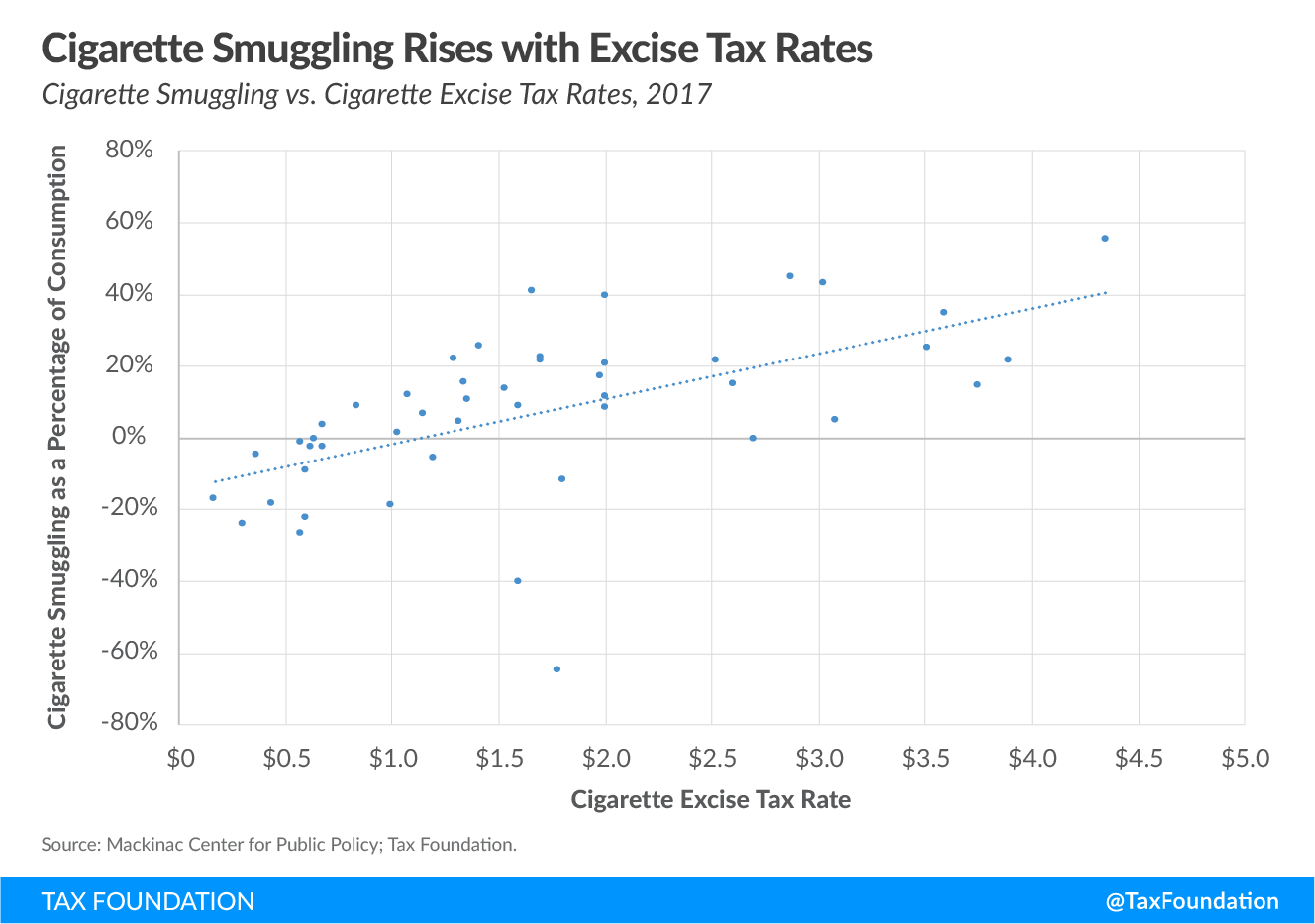
Each year, scholars at the Mackinac Center for Public Policy, a Michigan think tank, use a statistical analysis of available data to estimate smuggling rates for each state.[1] Their most recent report uses 2017 data and finds that smuggling rates generally rise in states after they adopt cigarette tax increases. Smuggling rates have dropped in some states, often where neighboring states have higher cigarette tax rates. Table 1 shows the data for each state, comparing 2017 and 2006 smuggling rates and tax changes.

New York is the highest net importer of smuggled cigarettes, totaling 55.4 percent of total cigarette consumption in the state. New York also has one of the highest state cigarette taxes ($4.35 per pack), not counting the additional local New York City cigarette tax ($1.50 per pack). Smuggling in New York has risen sharply since 2006 (+55 percent), as has the tax rate (+190 percent). In October, three people were charged in connection with smuggling cigarettes on the Staten Island Ferry. They were in possession of 30,000 untaxed cigarettes and $63,000 in cash.[2]

Smuggling in Pennsylvania has increased sharply since the last data release. The state increased the cigarette excise tax from $1.60 to $2.60 and as a result switched from having net outbound smuggling to net inbound smuggling. In 2015, Pennsylvania had outbound smuggling of 2.0 percent, but following the increase, the state inbound smuggling is at 14.7 percent. Over the same period, outbound smuggling increased in nearby low-tax Delaware, from 20.3 percent to 40.6 percent, suggesting that many cartons of cigarettes are crossing the border from one state to the other.

Other peer-reviewed studies provide support for these findings.[3] A 2018 study in Public Finance Review examined littered packs of cigarettes across 132 communities in 38 states, finding that 21 percent of packs did not have proper local stamps.[4]

As noted by LaFaive and Nesbit, authors of the Mackinac Center study, smuggling comes in different forms: “casual” smuggling, where smaller quantities of cigarettes are purchased in one area and then transported for personal consumption, and “commercial” smuggling, which is large-scale criminal activity that can involve counterfeit state tax stamps, counterfeit versions of legitimate brands, hijacked trucks, or officials turning a blind eye.[5]

The Mackinac Center has cited numerous examples over the many editions of this report, including stories of a Maryland police officer running illicit cigarettes while on duty, a Virginia man hiring a contract killer over a cigarette smuggling dispute, and prison guards caught smuggling cigarettes into prisons.

Policy responses in recent years have included banning common carrier delivery of cigarettes,[6] greater law enforcement activity on interstate roads,[7] differential tax rates near low-tax jurisdictions,[8] and cracking down on tribal reservations that sell tax-free cigarettes.[9] However, the underlying problem remains: high cigarette taxes amount to a “price prohibition” of the product in many U.S. states.[10]

International Smuggling and Counterfeiting Puts Consumers at Risk

While buying cigarettes in low-tax states and selling in high-tax states is widespread in the United States, other methods for evading federal, state, and local taxes are popular. One way that criminals grow their profits is by avoiding the legal market completely. They produce counterfeit cigarettes with the look and feel of legitimate brands and sell them with counterfeit tax stamps. Many of these products are smuggled from China, with one source estimating that Chinese counterfeiters produce 400 billion cigarettes per year to meet international demand.[11]

Global focus on counterfeit cigarettes has forced the criminals to innovate. A growing global problem is the so-called illicit whites or cheap whites. These products are produced legally in low-tax jurisdictions, but often intended for smuggling.[12]

These smuggled and counterfeit cigarettes are dangerous products as they do not live up to the quality control standards imposed on legitimate brand cigarettes. Pappas et al. (2007) find that counterfeit cigarettes can have as much as seven times the lead of authentic brands, and close to three times as much thallium, a toxic heavy metal.[13] Other sources report finding insect eggs, dead flies, mold, and human feces in counterfeit cigarettes.[14]

During prohibition of alcohol in the United States during the 1920s, increased enforcement did not manage to significantly decrease the prevalence of bootlegging because the profit margins were so large, and the distribution networks sophisticated. The same is true for today’s cigarette smugglers.

In June 2019, Canadian authorities arrested nine people who reportedly smuggled over one million pounds of tobacco (valued at CA $110 million). According to police the group was involved in both theft and arms trafficking.[15] Also this year, in Europe, authorities arrested 22 people across five countries. The organized crime organization is suspected of large-scale cigarette trafficking, assassinations, and money laundering, netting an estimated $750 million over the past two years.[16]

Global illicit trade in tobacco is a growing problem, but is considered low-risk, high-reward. Billions of dollars are made each year, and the trade involves corruption, money laundering, and terrorism.[17] According to the Financial Action Task Force (FATF): “Large-scale organized smuggling likely accounts for the vast majority of cigarettes smuggled globally.”[18] These operations hurt governments, who lose out on revenue; consumers, because the products often don’t adhere to health standards; legal businesses, which cannot compete with illicit products; and the general respect of the law.

A Cautionary Tale

Most vapor product users also smoked cigarettes.[19] With this in mind, we can imagine the behaviors of vapers to mirror those of smokers. Throughout the fall of 2019, both federal and state lawmakers have called for flavor bans and cigarette-level taxation of vapor products. As the data from cigarettes clearly show, the risk of creating a new black market or fueling an existing one with operators willing and able to supply nicotine products to consumers is significant.

There are already reports of nicotine-containing liquid coming into the U.S. from questionable sources.[20] In addition to tax evasion—costing states billions in lost tax revenue—black market e-liquid and cigarettes can be extremely unsafe.[21] The latest stories about serious pulmonary diseases have prompted the Food and Drug Administration (FDA) to publish a warning about black market THC-containing liquid (the psychoactive compound in marijuana).[22] Reports of illicit products containing dangerous chemicals resulting in serious medical conditions have been released over the last months.[23] Providing vapers with a well-regulated legal market will limit the distribution of illegal products.

On top of the dangers to consumers, the legal market would also suffer, as untaxed and unregulated products would have significant competitive advantages over high-priced legal products. This would impact not only the large number of small business owners operating over 10,000 vape shops around the country, but also convenience stores and gas stations relying heavily on vapers as well as tobacco sales. Policymakers should not lose sight of the law of unintended consequences as they set rates and regulatory regimes for tobacco and vapor products alike.

Source: Mackinac Center for Public Policy; Tax Foundation
State 2017 Tax 2017 Consumption Smuggled (positive is inflow, negative is outflow) 2006 Consumption Smuggled (positive is inflow, negative is outflow) 2017 Rank Rank Change since 2016 Excise Tax Rate change 2006-2017
AL $ 0.675 -2.50% 0.50% 34 1 59%
AK $2.00 NA NA NA NA 25%
AR $1.15 6.29% 3.9 26 2 no change
AZ $2.00 39.29% 32.10% 5 -3 69%
CA $2.87 44.55% 34.60% 2 5 230%
CO $0.84 8.82% 16.60% 23 1 no change
CT $3.90 21.40% 12.30% 11 4 158%
DE $1.60 -40.55% -61.50% 46 -2 191%
FL $ 1.339 15.16% 6.90% 16 3 294%
GA $0.37 -4.80% -0.30% 36 1 no change
IA $1.36 10.57% 2.40% 22 0 278%
ID $0.57 -26.77% -6.00% 45 1 no change
IL $1.98 17.20% 13.70% 15 1 102%
IN $ 0.995 -18.81% -10.80% 42 -1 79%
KS $1.29 21.81% 18.40% 10 4 63%
KY $0.60 -9.25% -6.40% 38 0 100%
LA $1.08 11.77% 6.40% 20 1 200%
MA $3.51 24.99% 17.50% 8 0 132%
MD $2.00 11.35% 10.40% 21 -3 100%
ME $2.00 8.28% 16.60% 25 0 no change
MI $2.00 20.55% 31.00% 14 -1 no change
MN $3.59 34.62% 23.60% 6 -1 149%
MO $0.17 -17.10% -11.30% 40 0 no change
MS $0.68 3.32% -1.70% 29 1 36%
MT $1.70 21.34% 31.20% 12 0 no change
NC $0.45 NA NA NA NA 50%
ND $0.44 -18.66% 3.00% 41 -2 no change
NE $0.64 -0.67% 12.00% 32 0 no change
NH $1.78 -65.04% -29.70% 47 0 123%
NJ $2.70 -0.50% 38.40% 31 -5 13%
NM $1.66 40.76% 39.90% 4 0 82%
NV $1.80 -11.85% 4.80% 39 -33 125%
NY $4.35 55.35% 35.80% 1 0 190%
OH $1.60 8.49% 13.10% 24 -1 28%
OK $1.03 1.03% 9.60% 30 1 no change
OR $1.32 4.19% 21.10% 28 -1 12%
PA $2.60 14.73% 12.90% 17 17 93%
RI $3.75 14.37% 43.20% 18 -1 52%
SC $0.57 -1.40% -8.10% 33 0 14%
SD $1.53 13.52% 5.30% 19 1 189%
TN $0.62 -2.78% -4.50% 35 1 210%
TX $1.41 25.18% 14.80% 7 2 244%
UT $1.70 22.13% 12.90% 9 2 145%
VA $0.30 -24.21% -23.50% 44 -2 no change
VT $3.08 4.77% 4.50% 27 2 72%
WA $ 3.025 42.79% 38.20% 3 0 49%
WI $2.52 21.20% 13.10% 13 -3 227%
WV $1.20 -5.81% -8.40% 37 6 118%
WY $0.60 -22.36% -0.60% 43 2 no change

Figure 1

Cigarette smuggling rises with excise tax rates

Figure 2

Cigarette smuggling by state

[1] See Michael LaFaive, Todd Nesbit, and Michael Lucci, “Smuggled Smokes: California Closes in on New York,” Mackinac Center for Public Policy, May 20, 2019, https://www.mackinac.org/archives/2019/Smuggled_Smokes_CA_NY.pdf; Michael D. LaFaive, Todd Nesbit, and Scott Drenkard, “Cigarette Taxes and Smuggling: A 2016 Update,” Mackinac Center for Public Policy, Dec. 19, 2016, https://www.mackinac.org/s2016-09; Michael D. LaFaive, Todd Nesbit, and Scott Drenkard, “Cigarette Smugglers Still Love New York and Michigan, but Illinois Closing In,” Mackinac Center for Public Policy, Jan. 14, 2015, http://www.mackinac.org/20900; Michael D. LaFaive and Todd Nesbit, “Cigarette Smuggling Still Rampant in Michigan, Nation,” Mackinac Center for Public Policy, Feb. 17, 2014, http://www.mackinac.org/19725; Michael D. LaFaive and Todd Nesbit, “Higher Cigarette Taxes Create Lucrative, Dangerous Black Market,” Mackinac Center for Public Policy, Jan. 8, 2013, http://www.mackinac.org/18128; Michael D. LaFaive and Todd Nesbit, “Cigarette Taxes and Smuggling 2010: An Update of Earlier Research,” Mackinac Center for Public Policy, Dec. 17, 2010, http://www.mackinac.org/14210; Michael D. LaFaive, Patrick Fleenor, and Todd Nesbit, “Cigarette Taxes and Smuggling: A Statistical Analysis and Historical Review,” Mackinac Center for Public Policy, Dec. 2, 2008, http://www.mackinac.org/10005.

[2] Irene Spezzamonte, 800 cartons of illicit cigarettes, $63,500 in cash seized on Staten Island, feds say, silive.com, Oct. 18, 2019, https://www.silive.com/crime/2019/10/feds-seize-800-cartons-of-illicit-cigarettes-63500-in-cash-on-staten-island.html.

[3] Cf Michael F. Lovenheim, “How Far to the Border?: The Extent and Impact of Cross-Border Casual Cigarette Smuggling,” National Tax Journal 61:1 (March 2008), https://www.ntanet.org/NTJ/61/1/ntj-v61n01p7-33-how-far-border-extent.pdf?v=%CE%B1&r=04833355782549953; R. Morris Coats, “A Note on Estimating Cross-Border Effects of State Cigarette Taxes,” National Tax Journal 48:4 (December 1995), 573-84, https://www.ntanet.org/NTJ/48/4/ntj-v48n04p573-84-note-estimating-cross-border.pdf?v=%CE%B1&r=35923133871196367; Mark Stehr, “Cigarette tax avoidance and evasion,” Journal of Health Economics 24:2 (March 2005), 277-97, http://www.sciencedirect.com/science/article/pii/S0167629604001225.

[4] Shu Wang, David Merriman, and Frank Chaloupka, “Relative Tax Rates, Proximity, and Cigarette Tax Noncompliance: Evidence from a National Sample of Littered Cigarette Packs,” Public Finance Review 47:2 (March 2019), 276-311.

[5] Scott Drenkard, “Tobacco Taxation and Unintended Consequences: U.S. Senate Hearing on Tobacco Taxes Owed, Avoided, and Evaded,” Tax Foundation, July 29, 2014, https://taxfoundation.org/tobacco-taxation-and-unintended-consequences-us-senate-hearing-tobacco-taxes-owed-avoided-and-evaded/.

[6] Curtis S. Dubay, UPS Decision Unlikely to Stop Cigarette Smuggling,” Tax Foundation, Oct. 25, 2005, https://taxfoundation.org/ups-decision-unlikely-stop-cigarette-smuggling/.

[7] See Gary Fields, States Go to War on Cigarette Smuggling,” The Wall Street Journal, July 20, 2009, http://www.wsj.com/articles/SB124804682785163691.

[8] Mark Robyn, “Border Zone Cigarette Taxation: Arkansas’s Novel Solution to the Border Shopping Problem,” Tax Foundation, Apr. 9, 2009, http://taxfoundation.org/article/border-zone-cigarette-taxation-arkansass-novel-solution-border-shopping-problem.

[9] See Joseph Bishop-Henchman, “New York Governor Signs Law to Tax Cigarettes Sold on Tribal Lands,” Tax Foundation, Dec. 16, 2008, http://taxfoundation.org/blog/new-york-governor-signs-law-tax-cigarettes-sold-tribal-lands.

[10] See Patrick Fleenor, “Tax Differentials on the Interstate Smuggling and Cross-Border Sales of Cigarettes in the United States,” Tax Foundation, Oct. 1, 1996, http://taxfoundation.org/article/tax-differentials-interstate-smuggling-and-cross-border-sales-cigarettes-united-states.

[11] Te-Ping Chen, “China’s Marlboro Country, Center for Public Integrity, June 29, 2009, https://reportingproject.net/underground/index.php?option=com_content&view=article&id=9:chinas-marlboro-country&catid=3:stories&Itemid=22.

[12] Roger Bate, Cody Kallen, and Aparna Mathur, “The perverse effect of sin taxes: the rise of illicit white cigarettes,” Applied Economics, Aug. 5, 2019, https://www.tandfonline.com/doi/abs/10.1080/00036846.2019.1646403?journalCode=raec20.

[13] R.S. Pappas et al., “Cadmium, Lead, and Thallium in Smoke Particulate from Counterfeit Cigarettes Compared to Authentic US Brands,” Food and Chemical Toxicology 45:2 (Aug. 30, 2006), 202-209.

[14] International Chamber of Commerce, Commercial Crime Services, “Counterfeit Cigarettes Contain Disturbing Toxic Substances,” https://icc-ccs.org/index.php/360-counterfeit-cigarettes-contain-disturbing-toxic-substances.

[15] CTV News, “Nine arrested in major contraband tobacco bust, June 26, 2019, https://montreal.ctvnews.ca/nine-arrested-in-major-contraband-tobacco-bust-1.4483651.

[16] The Guardian, “More than 20 arrested across Europe in swoop on drug gang,” May 22, 2019,  https://www.theguardian.com/uk-news/2019/may/22/22-arrested-across-europe-in-swoop-on-alleged-dangerous-drug-gang.

[17] DOS, DOJ, DOT, DOHS, DOHHS, “The Global Illicit Trade In Tobacco: A Threat To National Security,” December 2015, https://2009-2017.state.gov/documents/organization/250513.pdf.

[18] The Financial Action Task Force (FATF), “FATF Report: Illicit Tobacco Trade,” June 2012, 9, https://www.fatf-gafi.org/media/fatf/documents/reports/Illicit%20Tobacco%20Trade.pdf.

[19] Truth Initiative, “E-cigarettes: Facts, stats and regulations, July 19, 2018,  https://truthinitiative.org/research-resources/emerging-tobacco-products/e-cigarettes-facts-stats-and-regulations.

[20]Julie Bosman and Matt Richtel, Vaping Bad: Were 2 Wisconsin Brothers the Walter Whites of THC Oils?” The New York Times, Sept. 17, 2019, https://www.nytimes.com/2019/09/15/health/vaping-thc-wisconsin.html.

[21] National Research Council, Understanding the U.S. Illicit Tobacco Market: Characteristics, Policy Context, and Lessons from International Experiences (Washington, D.C.: The National Academies Press), 2015, 4.

[22] U.S. Food and Drug Administration, “Vaping Illness Update: FDA Warns Public to Stop Using Tetrahydrocannabinol (THC)-Containing Vaping Products and Any Vaping Products Obtained Off the Street,” Oct. 4, 2019, https://www.fda.gov/consumers/consumer-updates/vaping-illnesses-consumers-can-help-protect-themselves-avoiding-tetrahydrocannabinol-thc-containing.

[23] See David Downs, Dave Howard, and Bruce Barcott, “Journey of a tainted vape cartridge: from China’s labs to your lungs,” Leafly, Sept. 24, 2019, https://www.leafly.com/news/politics/vape-pen-injury-supply-chain-investigation-leafly; and Conor Ferguson, Cynthia McFadden, Shanshan Dong, and Rich Schapiro, “Tests show bootleg marijuana vapes tainted with hydrogen cyanide,” NBC News, Sept. 27, 2019, https://www.nbcnews.com/health/vaping/tests-show-bootleg-marijuana-vapes-tainted-hydrogen-cyanide-n1059356.

Blending Considerations for Minimum Taxes on Foreign Income

The passage of the Tax Cuts and Jobs Act in late 2017 introduced a new set of provisions for U.S. taxation of foreign income. One of those provisions defines Global Intangible Low Tax Income (GILTI), which was designed to subject some foreign income of U.S. companies to a minimum tax rate. The adoption of GILTI has created interest by other countries around the world in ways to implement a similar provision at the international level.

GILTI has created various policy challenges, however, among them a question of what high-taxed foreign income should be excluded from the policy. This is relevant not just to the U.S. policy debate, but also to the designs being considered by countries in the OECD’s Inclusive Framework: the level of blending that policymakers choose has implications for how a minimum tax will affect business decision-making. Specifically, the more granular the level of blending the higher the associated compliance costs and the impact on decisions related to expanding overseas business operations.

GILTI High-Tax Exclusion and Blending Considerations

GILTI is a definition of foreign-source income that is subject to U.S. tax. The basic mechanics of GILTI (a 10 percent exemption for investment, a 50 percent deduction, and an 80 percent limitation on foreign tax credits) can subject a business’s foreign income to additional U.S. tax at a rate between 10.5 percent and 13.125 percent. The story does not end there, though.

Because GILTI was layered on top of existing international rules, many businesses may face tax rates higher than 13.125 percent on GILTI. Existing U.S. rules require a portion of domestic expenses to be allocated to foreign income for purposes of the foreign tax credit. This expense allocation changes the impact of GILTI. If a business has significant domestic expenses allocated to foreign income, foreign income could be subject to GILTI even if (apart from expense allocation) the blending of foreign income and taxes results in a rate greater than 13.125 percent.

To address this issue, the Treasury has developed regulations to exclude some high-taxed foreign income from GILTI. Income could be excluded from GILTI if it has already faced a foreign tax of at least 90 percent of the domestic corporate rate (90 percent of the 21 percent corporate rate is 18.9 percent).

The proposed high-tax exclusion from GILTI comes with some caveats, though. Primarily, the high-tax exclusion would apply in a relatively narrow manner. A business wishing to exclude some of its foreign, high-tax income from GILTI would be required to calculate the tax rate on qualified business units, and then be able to exclude income from the business units that are taxed at greater than 18.9 percent.

This approach creates a few challenges. First, businesses with foreign operations often do not calculate tax rates at the business unit level. Second, this will create an extra tax impact for businesses when they are deciding where to set up operations and could create distortions as companies evaluate different location alternatives to make the high-tax exclusion from GILTI worthwhile. This impact would likely be significant for decisions related to opening a new business unit in a country with a tax rate just above or below 18.9 percent.

Alternatively, instead of applying the high-tax exclusion at the business unit level, Treasury could use a form of blending as part of the high-tax exclusion.

Blending foreign income and tax liability is baked into GILTI’s design. Businesses are expected to blend their foreign income and tax liability before calculating their GILTI liability. This is done at the (foreign) worldwide level.

The proposed regulations for the high-tax exclusion take the opposite approach by focusing on excluding highly taxed business units, essentially allowing zero blending of income and tax liability and creating previously discussed complications along the way.

In between full (foreign) worldwide blending and zero blending, there are several options that could be considered for the high-tax exclusion.

Companies could exclude income from GILTI if their foreign subsidiaries face a rate of tax above 18.9 percent. Foreign subsidiaries (specifically, controlled foreign corporations or CFCs) can own and operate many business units including sales, manufacturing, and distribution facilities. One benefit to blending at the CFC level is that businesses already calculate income and tax liability at this level and could know which CFC income could be excluded from GILTI without having to face a significant new compliance burden. Essentially, this would allow blending of business unit income and taxes at the CFC level before determining whether that income could be excluded from GILTI.

CFCs can cross country borders, though. Blending at the CFC level would therefore allow businesses to blend high-tax income in some jurisdictions with lower-tax income in other jurisdictions. This means that businesses could arrange the business units within their CFCs so that the overall tax rate faced by the CFC would be just above the threshold for being excluded from GILTI. This would allow both the low- and high-tax income in a CFC to be fully excluded from GILTI.

Another alternative would be to exclude income from GILTI at the country level. Companies would need to calculate their overall tax rate on a country-by-country basis and exclude income from countries where the tax rate is above the high-tax exclusion threshold of 18.9 percent. GILTI would then apply to income from countries where a business’s foreign income is taxed at rates below 18.9 percent.

Broadly speaking, the regulations for the high-tax exclusion will need to strike a balance between the basic design of GILTI (foreign worldwide blending) and a way to make the high-tax exception workable. Otherwise, businesses would be faced with the challenges of complying with a policy whose goals have already been undermined by the complication of expense allocation.

Blending Issues with the Global Minimum Tax

Among other significant proposals, countries in the OECD Inclusive Framework are considering an income inclusion rule that would create a global minimum tax. One of the key issues is a question of blending.

As already addressed, GILTI utilizes (foreign) worldwide blending to create a minimum tax. Recognizing the need to address opportunities for businesses to shift their foreign income to low-tax jurisdictions, policymakers chose a design that taxes foreign income at a minimum rate. Even with GILTI, businesses will be able to derive income from low-tax jurisdictions, but GILTI would apply when the blended foreign tax rate is below the GILTI rate.

If the policy goal at the OECD is to minimize the value of having income from low-tax jurisdictions rather than have at least some minimum rate apply (as is the case with GILTI), then countries could opt for a different level of blending. In fact, the recent consultation document lays out questions regarding worldwide, jurisdictional, and entity-level blending.

Worldwide blending not only allows for high- and low-tax income to be mixed, but the consultation document also points out that it could help to minimize volatility that comes from some foreign entities facing losses in some years. Blending would allow losses in some entities/jurisdictions to offset income in other jurisdictions.

Jurisdiction-level blending would minimize the tax benefits of locating operations in low-tax jurisdictions, and an entity-level global minimum tax would essentially allow zero blending and increase the role that taxes play in each decision to set up a new foreign entity.

The OECD proposal envisions using global consolidated financial statements as the starting point for the minimum tax. The consultation document notes that this starting point could create challenges for separating domestic tax and income from foreign tax and income. The challenges would be exacerbated if financial statements need to be spliced further to the jurisdiction level or the entity level.

Conclusion

Whether with the GILTI high-tax exclusion or the global minimum tax that the OECD is considering, the lower the level of blending, the more impact the minimum tax will have on compliance, taxes paid, and business decision-making.

A GILTI high-tax exclusion at the country level would allow businesses to know that new operations in higher-tax countries would not affect their GILTI blending, and investment decisions in other countries would only be impacted insofar as profits from those decisions increases or decreases their (non-high tax) blended tax rate.

However, if the OECD chooses to apply jurisdiction-level blending, and the minimum rate is in the low teens, then businesses would know the minimum possible rate they could face on any new investment. Countries with low statutory corporate rates like Hungary (9 percent), Ireland (12.5 percent), Bulgaria (10 percent), and many others would lose the relative attractiveness that their current corporate tax rates provide.

All of the approaches will have consequences for compliance costs and business decisions to invest in different countries. In turn, this will impact economic outcomes and the profitability of the affected companies. Policymakers should work toward solutions that meet their policy objectives while minimizing negative consequences.

Comparing Capital Gains Tax Proposals by 2020 Presidential Candidates

In less than two months, voters will cast their choice in the Iowa caucus to begin the process of selecting the next Democratic presidential candidate. The candidates currently in the top 3 polling positions—former Vice President Joe Biden, Senator Elizabeth Warren (D-MA), and Senator Bernie Sanders (I-VT)—have all proposed sweeping changes to the tax code, especially the taxation of capital gains and dividends.

Many Democratic presidential candidate proposals have focused on taxing high-income taxpayers’ accrued wealth and income, including capital gains. The tax code currently taxes any increase in a capital asset’s price over the asset’s basis when the asset is sold (or a realized capital gain), deferring taxation until the sale of the asset.

Capital assets can include everything from assets traded frequently in financial markets like stocks, to assets that are sold less frequently, like jewelry or art. Capital gains are taxed when they are realized, instead of every year on their accrued value. Investors can also deduct up to $3,000 in capital losses from their taxable income in the year the loss occurred, and can carry forward losses in excess of $3,000 to offset taxable income in future years.

Capital gains that are realized within a year (“short-term” capital gains) are taxed at the same statutory rates as ordinary income, but long-term capital gains (realized after one year) are taxed at lower rates: 0 percent, 15 percent, and 20 percent, depending on the filer’s taxable income (see Figure 1). The Affordable Care Act also created a Net Investment Income Tax, which imposes an additional 3.8 percent tax on the long-term capital gains of single filers who have a modified adjusted gross income (MAGI) of higher than $200,000, and married filers with a MAGI of more than $250,000.

2020 Tax Rates on Long Term Capital Gains
Source: “2020 Tax Brackets,” Tax Foundation and IRS Topic Number 559
For Unmarried Individuals For Married Individuals Filing Joint Returns For Heads of Households
Taxable Income Over
0% $0 $0 $0
15% $40,000 $80,000 $53,600
20% $441,450 $496,600 $469,050
Additional Net Investment Income Tax
3.8% MAGI above $200,000 MAGI above $250,000 MAGI above $200,000

This is where the top three Democratic presidential candidates stand on taxing capital gains and dividends:

Former Vice President Joe Biden

Biden has proposed taxing capital gains at ordinary income tax rates for taxpayers earning more than $1 million annually. He has also proposed increasing the top marginal income tax rate to 39.6 percent. When this is added to the Net Investment Income Tax (3.8 percent) on married filers (which phases in at $250,000 MAGI), the marginal tax rate on capital gains reaches 43.4 percent. Biden’s proposed changes would only affect filers in the top long-term capital gains bracket. Under Biden’s plan, the top rate on long-term gains would nearly double from 23.8 percent to 43.4 percent.

Income (Married Filing Jointly) Current Law Biden Plan
$0 to $78,749 0% 0%
$78,750 to $250,000 15% 15%
$250,001 to $488,849 18.8% 18.8%
$488,850 to $999,999 23.8% 23.8%
$1,000,000 and above 23.8% 43.4%

Senator Elizabeth Warren (D-MA)

Warren proposes taxing capital gains as ordinary income for the top 1 percent of taxpayers, raising the rate on capital gains from 23.8 percent to 39.6 percent for those in the top 1 percent of income earners in the United States. (In tax year 2017, the AGI threshold to be in the top 1 percent was $515,371.) She would also levy a new tax of 14.8 percent on investment income on individuals making more than $250,000 and couples more than $400,000.

Income (Married Filing Jointly) Current Law Warren’s Plan
$0 to $78,749 0% 0%
$78,750 to $250,000 15% 15%
$250,001 to $400,000 18.8% 18.8%
$400,001 to $488,849 18.8% 33.6%
$488,850 to Top 1% Threshold 23.8% 38.6%
Top 1% 23.8% 58.2%

Warren’s plan reaches a top marginal tax rate on capital gains of 58.2 percent. Additionally, she has proposed a “mark-to-market” taxation regime on capital gains for the top 1 percent of households. Mark-to-market taxation requires taxpayers to pay tax on their capital gains every year rather than waiting to pay tax until the assets are realized or sold. Warren’s proposal increases marginal tax rates on filers with incomes above $250,000, more than doubling the marginal rate for those in the top 1 percent.

Senator Bernie Sanders (I-VT)

Sanders’ proposal would tax capital gains at the same rate as ordinary income for taxpayers with household income of $250,000 and above, which is where the current Net Investment Income Tax (NIIT) phases in. Importantly, Sanders’ plan would raise marginal tax rates from current law, creating four new tax brackets: 40 percent on income between $250,000 and $500,000, 45 percent on income between $500,000 and $2 million, 50 percent on income between $2 million and $10 million, and 52 percent on all income over $10 million. Additionally, Sanders has proposed a 4 percent income-based premium on household income above $29,000, which we assume also applies to capital gains income.

Income (Married Filing Jointly) Current Law Sanders Plan (Includes Income-Based Premium)
$0 to $29,000 0% 0%
$29,001-$78,749 0% 4%
$78,750 to $250,000 15% 19%
$250,001 to $488,849 18.8% 47.8%
$488,850 to $500,000 23.8% 47.8%
$500,001 to $2 million 23.8% 52.8%
$2 million to $10 million 23.8% 57.8%
$10 million and above 23.8% 59.8%

Sanders’ plan taxes capital gains at the same rate as ordinary income for taxpayers with income of $250,000 and above. If his income-based premium on household income includes capital gains income, taxpayers who do not currently pay taxes on their capital gains could owe a 4 percent tax on their gains under his plan. Under Sanders’ plan, top marginal rates could reach 59.8 percent compared to current law, which peaks at 23.8 percent. Sanders’ plan would almost double marginal tax rates on all incomes between $250,000 and $2 million and more than double marginal tax rates on those with incomes above $2 million.

Similar Proposals with Contrasting Specifics

Biden, Warren, and Sanders would all tax capital gains at ordinary income tax rates for higher-income taxpayers. Biden’s proposal is the least progressive and contains the smallest marginal rate increase of the three candidates. Warren’s proposal features the highest marginal rate and would change the way gains are taxed for the top 1 percent. Sanders’ plan contains the most rate changes and affects taxpayers with lower levels of income than the other proposals.

Conclusion

With the first Democratic primary just around the corner, Biden, Sanders, and Warren have staked out similar plans to increase capital gains taxes on the wealthiest Americans. While all three candidates have called for taxing capital gains at ordinary income rates, the phase-in levels and top marginal tax rates vary.

With strong holiday sales comes great responsibility

By all accounts, sales records were smashed over the Thanksgiving weekend. That’s great for bottom lines but could create new and ongoing sales tax collection requirements for some retailers.

Thanksgiving Day sales exceeded $4 billion for the first time ever, Black Friday sales hit $7.4 billion, and Cyber Monday sales came in at a whopping $9.4 billion. (Cyber Monday sales in 2018 were $7.9 billion.)

At Amazon alone, Cyber Monday saw more sales than any other day since the company’s birth, and businesses selling through the Amazon marketplace “sold more items during Cyber Monday 2019 than any other 24-hour period in the company’s history.”

Although brick-and-mortar store visits trended down in much of the United States over the holiday weekend, ecommerce sellers reached more consumers than ever before. Retailers with both an online presence and brick-and-mortar store that allow consumers to buy online and pick up in store did especially well — a trend that’s expected to continue in the coming weeks; it’s hard to beat near-instant gratification after a late-night online shopping spree.

A high volume of sales over the five-day Thanksgiving weekend shopping period could put many retailers in the black. It could also tip an out-of-state seller into new sales tax collection obligations in one or more states — a requirement that would be ongoing.

Businesses with a physical presence in a state have always had to collect and remit that state’s sales tax. But out-of-state businesses with no physical tie to a state (remote retailers) couldn’t be required to register until the Supreme Court of the United States issued its ruling in South Dakota v. Wayfair, Inc. (June 21, 2018).

In the post-Wayfair world, states have the authority to base a remote sales tax collection obligation entirely on economic nexus, and most do. This time last year, fewer than 20 states required remote retailers to collect and remit sales tax. This holiday season, 42 states enforce economic nexus, including the biggies: California, New York, and Texas. Number 43, Louisiana, will enforce it on or before July 1, 2020.

There are five states with no general sales tax, and in one of them — Alaska — municipalities are banding together to enforce economic nexus at the local level (Alaska allows local sales tax). Only Florida and Missouri have a statewide sales tax but no economic nexus law, and they’re likely to fall in eventually.

Not all remote sellers have to collect sales tax in all states where they make sales. All but one state with an economic nexus law, Kansas, allow an exception for small sellers: Remote sellers collect sales tax only after crossing the economic nexus threshold.

The problem, for retailers with customers across the United States, is that each state’s threshold is unique. For example, it’s $500,000 in annual sales in California, Tennessee, and Texas, but $500,000 in sales and 100 transactions in New York. It’s $250,000 in Alabama and Mississippi, and $100,000 or 200 transactions in many states.

That’s not even the fun part. Each state bases the threshold on different sales, so while in some states only taxable sales of tangible personal property are included, in others both taxable and exempt sales must be counted. Some states include services or digital goods in the threshold, other don’t. And so on. State-specific details are available in this state-by-state guide to economic nexus laws.

Correctly determining whether economic nexus has been created in a given state requires no small amount of effort. But it can’t be overlooked — not even during the busy holiday season. Some states require a remote retailer to register as soon as the economic nexus threshold has been crossed. As in before the next sale. Picture that happening on Black Friday or Cyber Monday.

If there’s a silver lining for retailers — and that’s a big if — it’s that marketplace facilitators are required to collect and remit sales tax on behalf of their third-party sellers in 37 states (and Washington, D.C.) and counting. Retailers that sell only through collecting marketplaces in those states may not need to register. Or they may; it depends on the state.

There can be different requirements for businesses that make both direct and marketplace sales in a state with a marketplace facilitator law. A seller with a high volume of direct sales will likely need to register, collect and remit sales tax, and file returns for those sales, if not for their marketplace sales — though marketplace sales may also need to be reported. State-specific details are available in this state-by-state guide to marketplace facilitator laws and state-by-state registration requirements for marketplace sellers.

All these new collection requirements benefit states. According to the National Association of State Budget Officers, state sales tax revenue trended up in the 2019 fiscal year. Brick-and-mortar businesses that can’t sidestep sales tax also benefit when online sellers collect sales tax; the playing field is more level.

However, collecting sales tax in multiple states is a burden for sellers — a burden that will last for at least a year. Although sellers whose sales decrease below the economic nexus threshold in 2020 could eventually unregister and stop collecting (states have different rules about how soon that can happen), they’d need to reset the watch on their sales. If the threshold is crossed again, sales tax collection would have to resume. It may be simpler to simply keep collecting.

Manually collecting and remitting sales tax and filing returns in multiple states is untenable. It would necessitate tracking rate changes in 12,000+ jurisdictions, as well as rule changes and filing schedules in all the states. And more.

Fortunately, businesses don’t have to manage sales tax alone: Automating sales tax collection, remittance, and filing greatly eases the burden of sales tax compliance.

States that are members of the Streamlined Sales and Use Tax Agreement (SST) encourage remote businesses to contract with a Certified Service Provider (CSP) to perform most sales and use tax functions. There’s a similar CSP program in Pennsylvania, which isn’t an SST state, and there soon will be programs in several other states as well.

Avalara is a CSP in SST states and Pennsylvania. Learn how Avalara can facilitate sales tax compliance during the holidays and all year round.

Avalara Chief Financial Officer Bill Ingram to Join Board of Directors and Ross Tennenbaum to Become Chief Financial Officer on March 31, 2020

SEATTLE, WA — December 4, 2019 Avalara, Inc. (NYSE: AVLR), a leading provider of cloud-based tax compliance automation for businesses of all sizes, today announced that its chief financial officer (CFO), Bill Ingram, will retire March 31, 2020, and he will join the Board of Directors. Ingram will be succeeded as CFO by Ross Tennenbaum, Avalara’s executive vice president of strategic initiatives.

Ingram joined Avalara in December 2015 as chief financial officer, and built a finance team ready to manage a public company and lead the team through Avalara’s IPO. “I’m proud of our world-class team and strong financial operations, which enabled us to complete a successful IPO and follow-on offering,” Ingram said. “Avalara continues to deliver strong revenue and core customer growth, and the company is well positioned for the future.”

In his current role as executive vice president of strategic initiatives, Tennenbaum leads several business units grown from Avalara’s investments and acquisitions, representing many of the company’s primary growth initiatives. Tennenbaum’s experience was built over a 10-year investment banking career at Goldman Sachs and Credit Suisse, including working with Avalara for more than five years and leading its IPO in 2018. “Having been a part of the Avalara story both from the outside and on the inside, I understand what a great company Avalara is and what a strong team Bill has built,” said Tennenbaum. “I’m excited to have the opportunity to lead Avalara’s financial operations as we continue to support the company’s growth.”

“Bill has been an invaluable contributor to Avalara’s success during his four years with us,” said Scott McFarlane, Avalara’s chief executive officer. “We are fortunate to have benefited from Bill’s expertise and leadership, and we look forward to Bill’s continued support when he joins our Board. At the same time, we’re thrilled to have Ross already in place to lead our finance team and we expect a seamless transition between he and Bill. As demonstrated by this intended CFO transition, the Board and I are focused on building the next generation of leaders, which is critical in our pursuit of Avalara’s vision to be the leading global cloud compliance platform.”

Taxing Santa Claus – Wacky Tax Wednesday

Everyone knows Santa lives in the North Pole. Not everyone knows he pays sales tax on most items when he shops in town, or that he can avoid sales tax by staying home and shopping online. Word is he’s a bit of a recluse, so I have him for an Amazon Prime member.

But Santa’s tax-free days may be numbered. The City of North Pole, Alaska, is looking to tax online sales.

Currently, only businesses with a physical presence in North Pole are required to collect and remit tax — mail order and internet sales are exempt.

That could soon change.

States won the right to tax remote sales on June 21, 2018, when the Supreme Court of the United States ruled in favor of the state in South Dakota v. Wayfair, Inc. The Wayfair decision overruled the physical presence rule; while having a physical presence in a state still establishes a sales tax collection obligation, physical presence is no longer requisite.

In the year and a half since the decision, 43 of the 45 states with a general sales tax (plus Washington, D.C.) have adopted economic nexus: They now require sellers with no physical presence but a certain amount of sales and/or transactions in the state to register with the tax department and collect and remit sales tax.

The Alaska Municipal League (AML) is looking to do something similar at the local level. To that end, it’s created the Alaska Intergovernmental Remote Seller Sales Tax Agreement, which will “implement single-level, statewide administration of remote sales tax collection and remittance.” It will be overseen by the newly formed Alaska Remote Seller Sales Tax Commission.

To date, 15 cities and boroughs have signed the agreement. North Pole hasn’t, but North Pole Mayor Mike Welch did attend an AML workshop on remote sales tax in June. And during the December 2, 2019, North Pole City Council meeting, Welch said “an online sales tax is something we have to do.”

Still, he thinks North Pole won’t be taxing remote sales any time soon, likely not until late 2021. For now, most online sales remain tax free for residents of North Pole, Alaska, including Santa Claus. And I’m talking about the real Santa Claus — member of the North Pole City Council — as well as the mythical Saint Nick.

Other cities and boroughs in Alaska could require certain out-of-state sellers to collect and remit sales tax much sooner, as early as February or March 2020. Learn more about the local jurisdictions preparing to tax remote sales.

Trump Administration Proposes Retaliatory Tariffs against France’s Digital Services Tax

This past summer France approved a digital services tax (DST) which taxes the revenues of certain digital companies at a 3 percent rate. Because the tax was expected to mainly impact U.S. companies, the U.S. Trade Representative (USTR) opened a Section 301 investigation into whether the tax was discriminatory against the U.S. The investigation report was released yesterday along with a notice regarding proposed retaliatory tariffs.

The investigation report closely analyzes the policy and finds it is particularly discriminatory against U.S. companies and that the rationales rely on “incorrect or unproven” assumptions related to value creation by users of free digital services and the under-taxation of digital companies. The report references the work of the OECD by pointing out that the proliferation of digital technology makes it impossible to treat the digital economy as a separate entity.

The report has five specific conclusions that are the basis for the proposed retaliatory tariffs:

  1. The French DST is intended to, and by its structure and operation does, discriminate against U.S. digital companies, including by the selection of services covered and the revenue thresholds.
  2. The French DST’s retroactive application is unusual and inconsistent with prevailing tax principles and renders the tax particularly burdensome for covered U.S. companies.
  3. The French DST’s application to revenue rather than income contravenes prevailing tax principles and is particularly burdensome for covered U.S. companies.
  4. The French DST’s application to revenues unconnected to a physical presence in France contravenes prevailing international tax principles and is particularly burdensome for covered U.S. companies.
  5. The French DST’s application to a small group of digital companies contravenes international tax principles counseling against targeting the digital economy for special, unfavorable tax treatment.

Ambassador Robert Lighthizer, the USTR, says that the proposed retaliatory tariffs would cover approximately $2.4 billion in trade value. The targeted items include various types of cheeses, make-up products, handbags, and porcelain. Sparkling wine is another on the list. The notice states that tariff rates of up to 100 percent could be used.

The USTR is clearly aware of other DSTs that are in the process of being adopted or implemented. Ambassador Lighthizer specifically identified policies in Austria, Italy, and Turkey as potential candidates for future Section 301 investigations.

The proposed tariffs show that the U.S. is significantly concerned about the discriminatory and extraterritorial aspects of DSTs. It also shows that the U.S. is concerned about how unilateral actions like this will impact the multilateral tax negotiations that are ongoing at the OECD. In that vein, the report is skeptical of promises from the French government that the DST will be repealed once the OECD reaches an agreement by noting that a sunset or termination clause was not included in the final DST legislation.

The U.S. recognizes that a proliferation of unilateral measures like DSTs would increase barriers to trade. However, tariffs also create serious negative economic consequences, and the U.S. should focus on resolving its dispute with France in the context of the OECD. While the opportunity remains, policymakers should work towards a solution that does not result in harmful double taxation. Without such a solution, the chaotic nature of unilateral tax policy will continue to create uncertainty and harm prospects for growth.

It’s time to renew your Arizona TPT license

All businesses that have an Arizona Transaction Privilege Tax* (TPT) license must renew it by the end of the year because TPT licenses are valid for one calendar year only. Failure to renew the license by January 1, 2020, will lead to penalties, late fees, or both.

The renewal requirement even applies to licenses that were renewed or obtained sometime after January 1, 2019, as all TPT licenses set to expire on December 31.

It’s best for businesses to renew their TPT license online through AZTaxes.gov, and online license renewal is required for businesses with more than one location. Paper renewals are still available for companies with only one location in Arizona, though the Arizona Department of Revenue “strongly encourages taxpayers to enroll, file, and pay online.”

There’s no fee to renew a license at the state level, although first-time TPT licenses cost $12 plus applicable city fees. Local jurisdictions cannot charge more than $50 for a license.

In addition to in-state companies, businesses with no physical presence in Arizona may also need to obtain or renew an Arizona TPT license by January 1, 2020.

Arizona has enforced economic nexus since October 1, 2019: Remote retailers that have a certain volume in sales in Arizona are required to register with the Arizona Department of Revenue and obtain a TPT license.

To ease remote sellers into collection, Arizona’s economic nexus threshold is being reduced over a three-year period. Remote sellers must obtain a TPT license if the following thresholds were met in the previous or current calendar year:

  • $200,000 (2019)
  • $150,000 (2020)
  • $100,000 (2021 and beyond)

Having multiple thresholds could be confusing. It works as follows:

  • A remote seller must register in 2019 if it has more than $200,000 in direct Arizona sales during 2018 or 2019.
  • A remote seller must register in 2020 if it has more than $150,000 in direct Arizona sales during 2019 or 2020.
  • A remote seller must register in 2021 if it has more than $100,000 in direct Arizona sales during 2020 or 2021. The same is true in subsequent years.

Thus, a remote retailer with $175,000 in gross sales in Arizona wouldn’t have to register in 2019 but would have to register and comply with TPT requirements starting January 1, 2020. Additional details are available from the Arizona Department of Revenue.

Remote marketplace facilitators don’t get the same decreasing threshold. As of October 1, 2019, marketplace facilitators with at least $100,000 in direct or third-party sales in Arizona in the current or previous calendar year are required to collect and remit TPT on behalf of their third-party sellers.

The marketplace facilitator registration requirement can impact the registration requirements of remote marketplace sellers. Those that sell only through a registered marketplace that collects and remits TPT on their behalf are not required to register with the Arizona Department of Revenue. Sellers must register only if their direct sales into Arizona exceed the economic nexus threshold.

For additional details about Arizona’s requirements for remote sellers and marketplaces, check out Avalara’s state-by-state guide to economic nexus laws, state-by-state guide to marketplace facilitator laws, and state-by-state registration requirements for marketplace sellers.

To learn about registration requirements in other states, read Sales tax permits, a state-by-state guide.

*Arizona Transaction Privilege Tax functions much like a sales tax but is actually a tax on vendors for the privilege of doing business in the state.

Sales tax updates in North Carolina

Newly enacted laws in North Carolina could impact sales tax collection requirements for remote sellers, airlines, and professional motorsports teams.

Each state has its own definition for “gross sales,” “retail sales,” and other terms. In some states, for example, retail sales include some or all exempt transactions, while in others, they don’t. It’s one of the many fun quirks people who work with sales tax need to consider — along with the fact that these definitions are subject to change.

Previously, North Carolina defined “gross sales” as “the sum total of the sales price of all sales of items,” with “items” defined as “tangible personal property, certain digital property, or a service, unless the context requires otherwise.”

The new definition of “gross sales” is “the sum total of the sales price of all sales of tangible personal property, digital property, and services.”

This could impact the sales tax collection requirements of remote retailers that make sales into the state. Under North Carolina’s economic nexus law, an out-of-state seller must collect and remit North Carolina sales tax if the seller has more than $100,000 in gross sales or at least 200 separate transactions in the state in the previous or current calendar year.

Two existing sales tax exemptions that were set to expire on January 1, 2020, have been extended.

The exemption for sales of aviation gasoline and jet fuel to an interstate air business for use in a commercial aircraft, including a passenger aircraft, will remain in effect until January 1, 2024.

Likewise, a sales tax exemption for professional motorsports teams will now expire January 1, 2024.

Sales tax laws and rules are constantly tweaked for a wide variety of reasons. This is one of the reasons sales tax compliance is so challenging. Fortunately, it’s possible to automate sales tax compliance.