Updates on the R&D Amortization Fix

Updates on the R&D Amortization Fix

The One, Big, Beautiful Bill would provide one, big, beautiful deduction for R&D expenditures

The R&D Tax Credit has been significantly been hindered by the Section 174 amortization rules by requiring businesses to capitalize and amortize R&D expenses over several years, thus delaying the immediate tax benefits that were previously available. However, in a significant move to bolster domestic innovation, the newly proposed tax bill introduces pivotal changes to the treatment of domestic research and experimental expenditures. The “One, Big, Beautiful Bill” that promises to provide “One, Big, Beautiful Deduction” of R&D expenditures. Section 111002 aims to provide immediate relief for businesses engaged in research and development (R&D) activities within the United States. This marks the most promising proposal to walk back the R&D expenditure amortization requirements since they went into effect in 2022.

Suspension of Amortization

One of the key highlights of this proposed legislation is the suspension of amortization for domestic research and experimental expenditures. Specifically, Section 174 is amended to include a new subsection (e), which suspends the required application of amortization for such expenditures paid or incurred in taxable years beginning after December 31, 2024, and before January 1, 2030.

Reinstatement of Expensing

To further support R&D activities, a new section, 174A, is added. This section allows taxpayers to deduct domestic research or experimental expenditures paid or incurred during the taxable year providing immediate, albeit temporary, relief for US Manufacturers.

Key Definitions and Rules

Amortization Option: Taxpayers now have the option to amortize certain domestic research or experimental expenditures over a period of not less than 60 months, starting from the midpoint of the taxable year in which the expenditures are paid or incurred. For those who enjoy playing the long game.

Special Rules: The proposed legislation outlines specific rules for expenditures related to land acquisition or improvement, exploration expenditures, and software development, ensuring clarity and proper treatment under the new provisions.

Effective Date and Special Rules

The amendments generally apply to amounts paid or incurred in taxable years beginning after December 31, 2024. The Secretary of the Treasury may prescribe rules for the application of these amendments in the case of taxable years of less than 12 months beginning after December 31, 2024, and ending before the enactment of this Act.

This proposed legislation marks a significant step towards returning the Section 41 R&D Tax Credit to its intended purpose of stimulating domestic innovation by providing financial relief for businesses engaged in US-based research and development. By suspending amortization and reinstating expensing for domestic research and experimental expenditures, the legislation aims to encourage continued investment in R&D activities within the United States. With these changes, businesses can look forward to a more supportive framework that prioritizes growth, innovation, and competitiveness in a global economy.

Trump scores major win as Senate installs IRS critic to lead the agency

Trump scores major win as Senate installs IRS critic to lead the agencyHeading

By Alex Miller Fox News Published June 12, 2025 1:10pm EDT

Former Rep Billy Long will take the helm at the IRS amid Trump's plans to overhaul the US tax system

Steve Moore predicts new tax cuts will cause a ‘real rally’ in the economy

Former Trump economic advisor Steve Moore discusses the May jobs report, rising stock market numbers and more on ‘Fox & Friends Weekend.

Senate Republicans rammed through another of President Donald Trump’s nominees on Thursday, this time giving a green-light to the president’s pick to lead the IRS.

The GOP-controlled Senate approved former House Rep. Billy Long to be the next IRS commissioner in 53 to 44 vote along party lines. Long’s ascension to the role marks him as the fifth commissioner atop the tax agency since the beginning of this year.

Former Rep. Billy Long President Donald Trump’s nominee to be Internal Revenue Service commissioner, speaks during a Senate Finance Committee nomination hearing on Capitol Hill on May 20, 2025. (Andrew Harnik/Getty Images)

He will replace Michael Faulkender, who is serving as acting commissioner alongside his duty as deputy Treasury secretary. Long will also be taking over an agency that, like many others, saw drastic cuts to its workforce under the White House’s Department of Government Efficiency (DOGE) initiative. 

The former lawmaker and auctioneer will now lead an agency he once sought to dismantle.

Senate Majority Leader John Thune speaks with reporters about his plans to advance President Donald Trump’s spending and tax bill, at the Capitol on June 2, 2025. (AP Photo/J. Scott Applewhite)

Long, who served in the House from 2011 to 2013 representing Missouri’s 7th District, was grilled by Democrats on the Senate Finance Committee during his confirmation hearing last month.

Lawmakers questioned his backing of legislation that would have abolished the IRS and replaced income taxes with a national sales tax, and his promotion of a pair of tax credits – the Employee Retention Tax Credit and “tribal tax credits” – that raised questions of a possible conflict of interest with his new position.

President Donald Trump speaks during an “Invest in America” roundtable with business leaders at the White House on June 9, 2025. (AP Photo/Evan Vucci)

During the hearing, Long argued that as commissioner, he would have a chance to “make real, transformational change to an agency that needs it more than any other.”

But Trump has similarly sought to abolish the IRS and replace income taxes with tariffs, among other proposals. That means Long’s elevation to IRS commissioner likely gives the president a key ally in moving forward with his vision of seeing the tax agency scrapped.

Tax reconciliation bill makes headway

Tax reconciliation bill makes headway

By   Michael Cohn April 24, 2025, 5:17 p.m. EDT

President Trump’s “big, beautiful bill” extending the expiring provisions of the Tax Cuts and Jobs Act and adding more tax breaks is making progress in Congress, with key moves expected in May after lawmakers return from recess.

Earlier this month, House Republicans narrowly passed a budget blueprint echoing the budget outline passed by Senate Republicans. GOP lawmakers plan to use budget reconciliation rules to pass the package by a simple majority to avoid a filibuster by Democrats in the Senate, as they did in 2017 with the TCJA. They also hope to include a debt ceiling increase and border security, energy and defense provisions in the package, along with spending cuts that Democrats warn could threaten Medicaid funding. However, the parameters are still being worked out and only the broad outlines of the overall plan have been approved so far.

Besides extending the individual and pass-through business provisions of the TCJA that weren’t already made permanent, Republicans hope to add more tax breaks such as President Trump’s campaign promises to eliminate taxes on tips, overtime pay and Social Security income. 

“I think the final version of the Senate reconciliation instructions gives them a little more breathing room on tax that will allow them to do some things, particularly on the business side, that might have been tough and with less pressure for really painful revenue raisers,” said Dustin Stamper, managing director of tax legislative affairs at BDO USA. “I don’t think they’ll be entirely free of some tough choices between tax priorities, but they certainly got a little more breathing room than they would have had under the original House version.”

Current policy baseline

The bill would raise the debt limit by $5 trillion and cut taxes by up to $5.3 trillion over a decade, likely adding $5.8 trillion to the national debt by 2034. However, Republicans hope to use an assumption called the “current policy baseline” to assert that the $3.8 trillion cost of extending the existing tax cuts would essentially equate to zero, paving the way for $1.5 trillion in additional tax cuts.

“The use of a current policy baseline unlocks a couple new possibilities, but it doesn’t come without its own set of questions,” said Stamper. “There’s not a lot of precedent for using the current policy baseline to score tax provisions under a reconciliation bill.”

When Republicans and Democrats have used the reconciliation maneuver in the past, they’ve left it up to the Senate’s nonpartisan parliamentarian to decide what’s permissible or not under the rules. But the parliamentarian will have less discretion under the current bill. 

“What the budget does is essentially asserts that the Senate Budget Committee chair has the authority to determine how scoring works, and the budget specifically lays out that the current policy baseline is essentially appropriate,” said Stamper. “What we heard from the Senate Majority Leader, John Thune, is that they consulted on the budget resolution with the parliamentarian, who apparently deemed it appropriate. But we don’t know how deep that consultation went, whether it went through discussions of all the possible permutations or questions that could arise under that kind of concept. So there is a little bit of lingering uncertainty there on how this could play out.”

Like Stamper, Michael Masciangelo, BDO’s international tax services practice leader, does not anticipate much interference from the Senate parliamentarian. 

“I think the tack that was taken by the Senate when they agreed to their parameters was that they felt like they did not need the budget parliamentarian to agree to the scoring approach,” said Masciangelo. “The Senate felt that they had the authority they needed to adopt an approach, whether the parliamentarian agreed to it or not.”

Republicans hope to reverse some of the provisions in the TCJA that were supposed to eventually raise revenue to offset the cost of the 2017 bill after a few years such as amortization of research and development costs and phasing out 100% bonus depreciation.

“What does a current policy baseline mean for something like bonus depreciation, which isn’t just expiring as of a single date, but it’s drawing down over a range of years,” said Stamper. “Or what does a current policy baseline mean for unfavorable business provisions that took effect in 2022 like amortization of research costs, or the less favorable calculation of the limit on interest deduction under 163(j)? Can you include a retroactive extension like that in a current policy baseline?”

Senate Democrats are likely to try to challenge such maneuvers, but they have limited power right now.

“Democrats will absolutely be trying to shred this with budget points of order,” said Stamper. “We’ll see what can fly and what the parliamentarian rules.”

Under reconciliation, every provision generally needs to have a revenue impact that’s not merely incidental, he noted. 

“To the extent the current policy baseline means that extensions of expiring provisions have no revenue impact, then do they alternatively run afoul of this separately? Republicans have sort of discussed that, and we’ve heard some rumblings that they could tweak some of the different provisions instead of having a straight extension,” said Stamper. “But we don’t know exactly what that would look like and how much they’d have to tweak them to satisfy the parliamentarian. There’s not a ton of precedent for using that rule on tax provisions, because usually tax provisions inherently have a meaningful revenue impact.”

Debt limit

Republicans had hoped to get the bill to President Trump’s desk by Memorial Day, but that timeline is looking uncertain now as Congress starts looking at other priorities from the Trump administration. The idea of including the debt limit in the bill will affect the timing. 

“The debt limit is an interesting thing to include because it might change the timeline of when they need to get a bill done,” said Stamper. “I think they’re looking to work pretty quickly either way, but their drop dead date, technically, under the budget rules, is Sept. 30, 2025 because that’s when the government fiscal year ends. But if they plan to address the debt limit as part of this legislation, then they may need to act sooner than that. CBO’s latest projections say sometime in August or September is likely when they’ll need to act in order to avoid a default. A lot of that is caveated. It could come even earlier than that if government receipts unexpectedly come in low. Now, Republicans can always try and address the debt limit outside of the reconciliation process, but that probably means working with Democrats and may lead to some policy concessions that they don’t want to make.”

SALT cap, carried interest and millionaire tax

Among the tax provisions under consideration are raising the $10,000 limit on the state and local tax deduction in the TCJA. Democrats from high-tax blue states like New York and California have long opposed the so-called “SALT cap,” but now Republican lawmakers in those same states are threatening to withhold their votes if the limit isn’t raised.

“I think they will absolutely have to provide some SALT cap relief in order to get a bill from the House,” said Stamper. “There are enough Republicans that are choosing that hill to die on that I think we won’t see a straight extension of the $10,000 cap. We’ll see some adjustment to it. Where that ends up is going to be subject to some pretty intense negotiations. One of the more recent developments we’ve heard is the tax writers’ first offer seems to be a $25,000 cap. The initial response from what I’ll call the Republican SALT Caucus has been that’s not nearly enough, so we’ll see where that eventually lands.”

President Trump has also called for eliminating the carried interest tax break that mainly benefits hedge fund managers, private equity firm partners and venture capitalists, but lobbyists have successfully defended the tax break in the past.

“This is an interesting issue, because Trump is really the one driving it and he’s mentioned it several times, and targets it specifically,” said Stamper. “There’s a little bit of irony here too, because the current treatment of carried interest is rather unpopular with Democrats, but as much as they’ve yelled about in the past, they’ve never actually passed legislation addressing it. The only time we’ve seen legislation addressing it is when Republicans had single-party control the last time, when the Tax Cuts and Jobs Act extended the holding period. Clearly, it’s in the crosshairs again, but there are going to be a lot of sympathetic Republican members that would like to preserve the current tax treatment. I think their goal is going to be to either try and do something marginal that you know can satisfy or distract the president while still preserving most of the underlying rule”

There has also been talk about having a higher tax rate for millionaires as a way to help pay for the bill, but Trump seems to have dismissed the idea this week, saying it would prompt millionaires to leave the country.

“Some of the hardest core deficit hawks and some members of the Freedom Caucus have floated that trial balloon,” said Stamper: “What if we scale back the tax cuts for folks at the highest income levels, maybe over a million dollars, or something like that. Trump, in private meetings, has expressed openness to that. I think there’s going to be a lot of Republicans, though, that consider their party the party of tax cuts, not tax increases, and will be looking to defend those lower rates as critical to pass-through businesses and things like that. It’s not impossible that something like that moves forward, but I don’t necessarily think it looks extremely likely, notwithstanding some of the chatter that we’ve heard over the last couple of weeks.”

Corporate taxes

During the campaign, Trump called for lowering the corporate tax rate for companies that manufacture in the U.S.

“There’s an interesting dynamic with that one, because Trump really talks about that in terms of a lower rate specifically for domestic manufacturing, and we’re not sure yet exactly what that might mean,” said Stamper. “The easiest concept they can resurrect is an old provision under Section 199 called the Domestic Production Activities Deduction, or DPAD. It was a deduction that gave you an equivalent rate on what it tried to define as manufacturing activities.”

However, such a tax break could be difficult for the IRS to police, especially given the recent cutbacks in its ranks.

“The problem with that provision was that it was hard for the IRS to administer and for taxpayers to comply with, and advisors had cracked it pretty wide open so that there was probably a lot more you could get that deduction on than was originally intended by Congress,” said Stamper. “It’s hard for lawmakers to design and enforce a rate cut on a specific activity like manufacturing. In addition to that, it’s expensive, and one of the things that I’ve noticed is there don’t seem to be a lot of business lobbying groups clamoring for that rate cut right now, which is very different from what it looked like in 2017 when it was all about getting the corporate rate lower for businesses and the administration. That was sort of the centerpiece of the economic agenda and the tax policy. Now that provision is a little more of an afterthought.”

Republicans hope to make more of the provisions in the reconciliation bill permanent, as they did with many of the corporate provisions in the TCJA.

“That’s the biggest benefit for Republicans of the current policy baseline is that they plan to use it to make elements of the Tax Cuts and Jobs Act permanent,” said Stamper. “To the extent they want to go beyond just extensions of the Tax Cuts and Jobs Act and do maybe some enhancements to certain other provisions, or some of the other things they’re talking about, like the new tax cuts Trump has promised, if they want to make those permanent, they would need permanent revenue offsets, so tax increases and things like that could absolutely still be on the table. Carried interest is one. Republicans have targeted the endowment taxes for higher education institutions. They’ve talked about repealing some energy incentives. They have discussed limiting the deduction for state and local taxes for corporations and businesses. So even though the budget resolution, the way the Senate has written it, gives them a little more breathing room, some of these tax increases could absolutely still be on the table.”

Indeed, Trump has talked about eliminating many of the tax incentives for green energy such as wind and solar from the Biden administration’s Inflation Reduction Act, but many of the projects are located in Republican-leaning states, which may make it difficult to end those tax credits.

“In terms of energy credits, I do think they’re not going to be able to pull these up by the roots, in the way that some of the most aggressive rhetoric suggests,” said Stamper. “There is a decent amount of Republican support for some of the energy incentives, because there’s a lot of investment going into red states and red districts. Last year, we saw 18 Republican House members, including 14 who are still in Congress now, write to the House Speaker asking him to preserve some of the energy credits. And his response was we’ll take a scalpel and not a sledgehammer.”

More recently, four Republican senators have written a similar letter calling for the preservation of some of these energy incentives, he noted. 

“We could still see some action here, but it’s likely to be in the margins and not a wholesale repeal of these credits,” said Stamper. “In addition, potentially, to the extent there are changes, they’re most likely to be prospective for projects beginning construction after some date in the future, so people with projects already under construction or about to start projects are likely safe.”

International taxes

On the international tax side, there may be some changes as well in the reconciliation bill, although they’re not set to expire like the TCJA’s individual tax provisions. The TCJA included a number of international tax provisions, including global intangible low-taxed income (GILTI), base erosion and anti-abuse tax (BEAT) and the deduction on foreign-derived intangible income (FDII) for U.S. corporations. 

“We’re expecting to see in the legislation right now changes in terms of an increase in the BEAT rate, and mechanical change in how the BEAT liability is compared to regular tax liability, by way of which credits are considered, I call them good or bad credits in the current provisions,” said Michael Masciangelo, BDO’s international tax services practice leader. “The GILTI rate is scheduled to go up from a 10 and a half percent rate to 13.125%, absent any extension of the current rules or changes to the rules. And then the benefit of FDII is scheduled to go down from roughly a 13.125% rate on qualifying FDII income to up to roughly 16.4%. Those are the big three.”

There may also be changes in some of the rules for controlled foreign corporations, which were last extended in 2020, but not as part of the TCJA. “It doesn’t get as much press because it wasn’t per se a TCJA item, but the CFC-to-CFC look-through rules, 954(c)(6), are also scheduled to expire as of 12/31/2025,” said Masciangelo. “Those rules, which have been around for quite some time and were temporary from the outset and have been continuously extended, but are scheduled to expire at the end of 2025. We’re watching those things with close interest. We’ll know a lot more in the coming weeks, now that the House agreed to the budget parameters, aligning itself with the Senate in terms of a current policy approach to budget scoring, as opposed to a current law approach, which has been generally speaking used historically for reconciliation bills.”

Other provisions he’s keeping an eye on include Section 174, the R&D capitalization provisions, as well as the Section 163(j) rules limiting the deductibility of business interest expenses. 

On the international tax side, the U.S. seems to be pulling away from efforts by the Organization for Economic Cooperation and Development to develop a two-pillar framework to deter corporate tax avoidance. On Inauguration Day, Trump signed an executive order saying, “The Secretary of the Treasury and the Permanent Representative of the United States to the OECD shall notify the OECD that any commitments made by the prior administration on behalf of the United States with respect to the Global Tax Deal have no force or effect within the United States absent an act by the Congress adopting the relevant provisions of the Global Tax Deal.” 

It’s unlikely that GOP lawmakers will be trying to bridge the gap with the OECD now, or to support efforts by the United Nations to create a global tax framework after the U.S. delegate walked out of the talks in February.

“I’d be surprised if there was legislation adopted that would enact Pillar One and/or Pillar Two associated legislation as part of the upcoming tax legislation,” said Masciangelo. “I think the administration has been pretty clear as to its view on Pillar One and Pillar Two around sovereign taxing rights. What remains to be seen is if there are attempts, legislatively, in the reconciliation bill to try and adopt any of the provisions combating other jurisdictions that have enacted digital services taxes in some instances and/or certain aspects of the Pillar Two legislation.”

He noted that the Treasury Department has been studying the issue of taxes levied in other countries, but has not yet released its report. 

“That report has not been made public in terms of the review of countries that are at least under the guidelines that were highlighted in the executive orders or memoranda from the administration to examine countries to determine whether they had regimes or laws that would discriminate against U.S. companies,” said Masciangelo. “That report is out there. I doubt that we’ll see it, at least in the coming weeks. And, whatever is in that report, and some of the recommendations may or may not find their way into tax legislation as revenue raisers, I think it’s a difficult thing to do because of treaties and other types of things that need to be considered.”

The report may look at issues such as digital services taxes, value-added taxes, top-up taxes and the OECD’s undertaxed profits rule. The OECD is still hoping to work with the U.S. and other recalcitrant countries on a way forward.

“At least in the public press, I think the OECD continues to state that they feel like they can work with the U.S. around Pillar Two and try to come to an agreement on items, whatever those agreements may or may not be,” said Masciangelo. “There are also other big countries besides the U.S. that are members of the OECD that have yet to adopt Pillar Two legislation as well. So we’re not alone in the U.S. in terms of not having advanced domestic law to adopt Pillar Two provisions like you’ve seen in many other places around the world.”

It will be up to the IRS and the Treasury to develop regulations around any legislative changes, which may be difficult to do given the budget cuts and layoffs.

“Unless they change the mechanics or certain key definitions of items in the reconciliation bill related to BEAT, GILTI and FDII, I think the regulations that exist now will suffice in terms of anticipating the changes to the rates and mechanics that will happen in 2026,” said Masciangelo. “Those changes were already considered in the rather substantial regulation packages that were issued post TCJA up until now for those particular provisions when they were released. If we see fundamental changes to any of those regimes, and it requires regulations to supplement what we already have, I think you might expect to see some movement on those regulations. Even with the first Trump administration, when there was a heightened scrutiny on proposing regulations and needing to remove a certain subset of other rules or regulations in response, there was, generally speaking, an exception to that to issue regulations related to the TCJA itself. I would imagine that same point of view would likely apply to any new or significantly changed provisions in the current reconciliation bill, but we’ll have to see.”

Relatively few small businesses aided by COVID tax relief

Relatively few small businesses aided by COVID tax relief

By Michael Cohn from Accounting Today August 03, 2022, 2:08 p.m. EDT 4 Min Read

Small business owners have been hampered by complicated tax forms and processes that kept them from claiming pandemic-related tax credits and payroll tax deferrals, according to a new government report. Only up to 7% of small business owners were able to claim the tax relief, and they fell mainly within specific racial, ethnic and gender groups.

The report, released Wednesday by the Government Accountability Office, found the tax forms for claiming the paid sick and family leave credits and payroll tax deferrals for employers and the self-employed, as well as the Employee Retention Credit, were too complex. They had difficulty getting help from both the Internal Revenue Service and even from tax professionals.

While accountants and tax pros largely found the COVID-19 aid boosted their services to clients to help them claim Economic Impact Payments, tax credits and Small Business Administration programs like the Paycheck Protection Program and Economic Injury Disaster Loans offered through pandemic relief packages like the CARES Act, the Families First Coronavirus Response Act and the American Rescue Plan Act, many small businesses and self-employed taxpayers still had trouble getting assistance. The GAO report found limited use of the tax provisions by small businesses, with less than 7% of eligible small businesses within the study population using the employer and self-employed leave credits or payroll tax deferrals. 

COVID-19 tax provisions were aimed at helping employers and the self-employed maintain payroll and address health-related leave. But we found that some small business owners struggled to use these tax provisions — partly because they didn’t know how.

A man walks past the IRS headquarters in Washington, D.C.
 
The IRS headquarters in Washington, D.C.
Andrew Harrer/Bloomberg

“Our review of relevant tax forms found that claiming the provisions was a complex process,” said the report. “Small business representatives said it was hard to get clear information from the IRS and to access professional tax help.”

The GAO recommended the IRS should evaluate how it can improve outreach to small businesses, especially when tax provisions are introduced or changed. The agency may also need to do outreach to specific populations as well. The IRS doesn’t break out the racial, ethnic and gender demographics of small business taxpayers in its statistical data, but the report nevertheless looked at the demographics of the small businesses who did receive COVID tax relief, using data from other federal agencies, other taxpayer information and analytical methods to help identify or estimate taxpayers’ demographic characteristics. The GAO analyzed the use of COVID-19 tax provisions among a study population of single-owner businesses in tax year 2020, matching the data from different agencies such as the U.S. Census Bureau and the Social Security Administration to identify the recorded sex of business owners and estimated race and ethnicity of selected taxpayers using a method that calculates the probability that a person with a given surname and residential location will identify with selected racial and ethnic groups.

For example, for self-employed leave credits, the GAO estimated that eligible Black or African American- and Hispanic-owned businesses were more likely to use these credits compared to Asian- and white-owned businesses. For the employee retention credit, the GAO found that a slightly higher percentage of female-owned and Asian-owned businesses claimed the ERC compared to other businesses filing employment tax returns.

The GAO talked to some organizations and agencies representing small businesses, and nearly all of those interviewed cited a poor understanding of the tax provisions as a potential cause of the limited use, especially among very small businesses. The information and recordkeeping requirements are another potential barrier contributing to limited use. The report acknowledged the IRS did provide information to small businesses about the provisions and used some measures to evaluate its outreach, including informal feedback and compliance data, but GAO believes those measures didn’t provide relevant and complete information.

The period of eligibility has largely passed for the COVID-19 provisions studied by the GAO, but the report points out that evaluating outreach could improve the IRS’s preparations for communicating tax relief information to taxpayers during future emergencies. That could also help with communicating about tax relief to specific demographic groups. A January 2021 executive order from the White House on advancing racial equity asked agencies to assess their programs and policies to see if they perpetuate systemic inequalities among groups, while the Treasury Department’s strategic plan includes equity goals involving outreach and education to underserved communities. The report noted that evaluation of ongoing outreach efforts could help the IRS develop information that could be useful to groups with different needs, including very small businesses and owners from various demographic backgrounds. 

The GAO recommended that the IRS evaluate its outreach efforts to very small businesses and owners with diverse backgrounds, using relevant and complete information, to inform future outreach. The IRS agreed with this recommendation, but pointed to the complexity of evaluating outreach without demographic data.

“The unprecedented COVID-19 pandemic illustrates the significant role that the IRS plays in the overall health of our country,” wrote IRS chief risk officer Mark Pursley in response to the report. “We were called upon to take on new responsibilities impacting almost every American during this national crisis while also fulfilling our routine responsibilities of tax administration.”

Inflation Reduction Act potentially doubles R&D tax credit

Inflation Reduction Act potentially doubles R&D tax credit

By Michael Cohn from Accounting Today August 18, 2022, 5:10 p.m. EDT 3 Min Read

The Inflation Reduction Act that President Biden signed into law this week has a lesser known provision that could benefit many small business startups, allowing them to potentially double the amount they can claim on the research and development tax credit from $250,000 to $500,000 per year against payroll taxes.

Under current law small businesses that may not have enough income tax liability to take advantage of their research and development credit can apply up to $250,000 of the credit toward their Social Security payroll tax liability, according to Top 100 Firm Marcum LLP. To qualify for the expanded credit, the small business would need to have less than $5 million of gross receipts and be less than five years old. The Inflation Reduction Act would permit an additional credit of up to $250,000 to be applied against the Medicare payroll tax for tax years starting after Dec. 31, 2022.

The expanded R&D tax credit probably won’t show up on tax returns until 2024 since it can first be claimed for tax year 2023, but it could boost small businesses, particularly the startups that it can incentivize.

biden-joe-manchin-inflation-reduction-act.jpg
 
President Joe Biden signs H.R. 5376, the Inflation Reduction Act of 2022, in the State Dining Room of the White House.
Sarah Silbiger/Bloomberg

“Just by virtue of having it in this historic bill shows just how significant this credit is viewed by both sides of the aisle,” said Chris Winslow, CEO of Clarus R+D,  a fintech software company that helps businesses claim R&D tax credits. “It continues a legacy of support for research and development in the U.S. This particular change is focused on small businesses, which are the cornerstone of innovation and growth in the U.S. This shows a recommitment by the federal government to support those small businesses as they expand their R&D capabilities and investment.”

He expects to see additional guidance on claiming the tax credit to be released by the Internal Revenue Service and the Treasury Department.

“More details will need to be wrapped around this, but it’s essentially raising the cap for small businesses from $250,000 today to be applied to payroll taxes, primarily FICA, to an additional $250,000 that will be allowed against the Medicare hospital insurance coverage,” he said. “Our research shows that only about half the people who are qualified to take the credit actually take the credit. I think the more opportunities to use the credit and the higher limits that people can claim will expand the overall market and and create more opportunity to fund innovation for today’s R&D customers.”

There will be some hurdles as the IRS has been increasing the requirements lately for documenting R&D activities, but Winslow noted that there have always been some requirements for documentation, which is what his software helps companies do.

“Because of the amount of credits, there is an opportunity going forward for additional requirements by the government to demonstrate the research and development activities that qualify for this credit in addition to the calculation of the credit amount,” he said. “This is what we’ve invested in heavily over the last five years is our software platform that creates efficiency for our customers to enter all the appropriate information that demonstrates their qualification under the law, but in addition creates a highly detailed compliant report that supports the requirements that the IRS has for demonstration of research and development activities that qualify.”

A September 2021 memorandum from the IRS Office of Chief Counsel said it wants more detailed information about all the business components for which the research credit claims relate for that year (see story). For each business component, companies will need to identify all the research activities they’ve performed and name the individuals who performed each research activity, along with the information each individual sought to discover. Refund claims for the research and development credit will also need to detail the total qualified employee wage expenses, total qualified supply expenses, and total qualified contract research expenses for the claim year, using Form 6765. The additional requirements have led to some consternation among companies and tax professionals (see story). But the expansion of the R&D credit under the Inflation Reduction Act should spur more interest in claiming the credits among companies, especially tech startups.

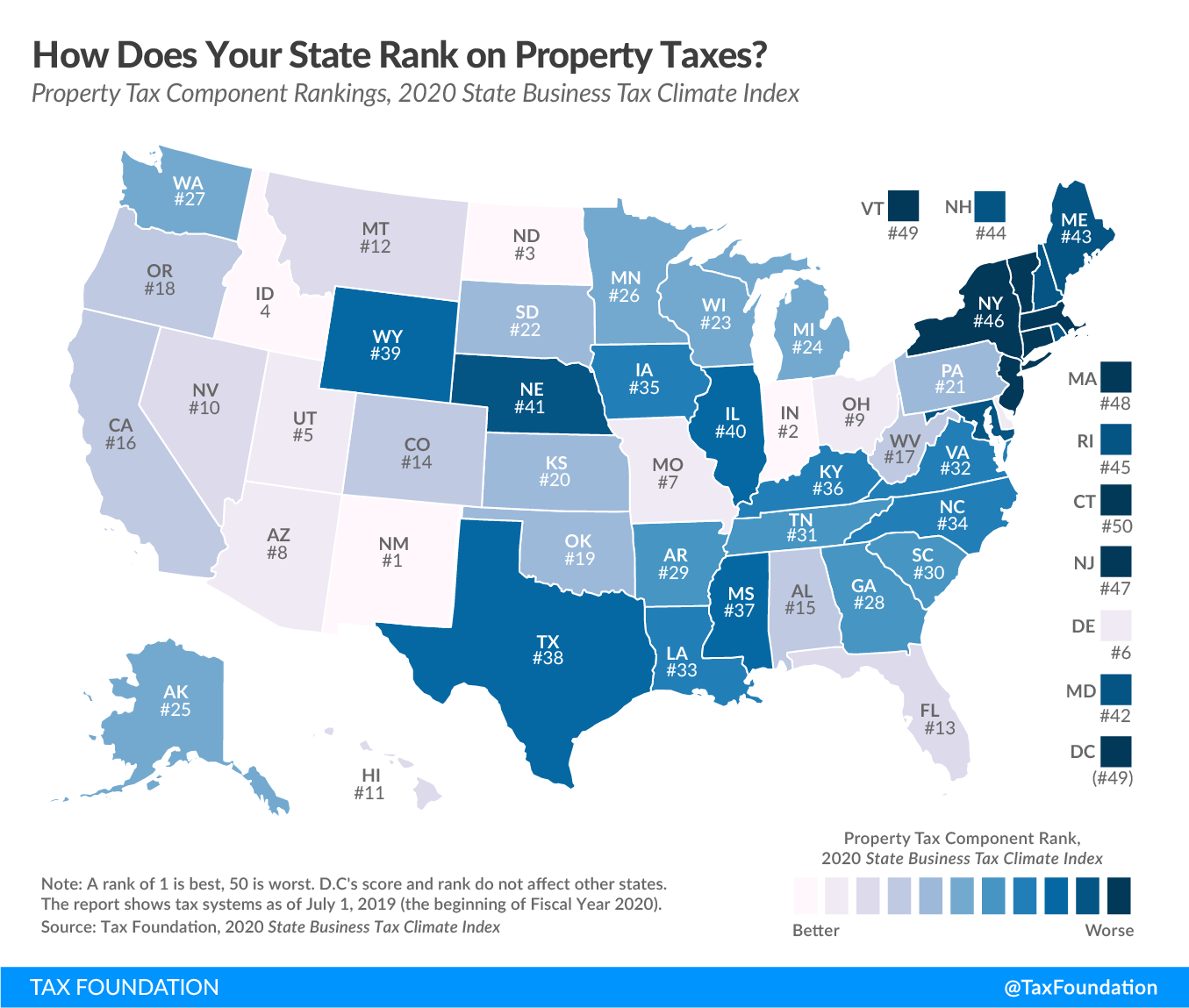
Ranking Property Taxes on the 2020 State Business Tax Climate Index

Today’s map shows states’ rankings on the property tax component of the 2020 State Business Tax Climate Index. The Index’s property tax component evaluates state and local taxes on real and personal property, net worth, and asset transfers. The property tax component accounts for 16.6 percent of each state’s overall Index score.

Property taxes matter to businesses for several reasons. First, businesses own a significant amount of real property, and tax rates on commercial property are often higher than the rates on comparable residential property. Many states and localities also levy taxes not only on the land and buildings a business owns but also on tangible property, such as machinery, equipment, and office furniture, as well as intangible property like patents and trademarks. Across the nation, property taxes impose one of the most substantial state and local tax burdens most businesses face. In fiscal year 2018, taxes on real, personal, and utility property accounted for 38 percent of all taxes paid by businesses to state and local governments, according to the Council on State Taxation.

Although taxes on real property tend to be unpopular with the public, a well-structured property tax generally conforms to the benefit principle (the idea in public finance that taxes paid should relate to benefits received) and is more transparent than most other taxes.

Taxes on intangible property, wealth, and asset transfers, on the other hand, are harmful and distortive. States that levy such taxes—including capital stock taxes, inventory and intangible property taxes, and estate, inheritance, gift, and real estate transfer taxes—are less economically attractive, as they create disincentives for investment and encourage businesses to make choices based on the tax code that they would not make otherwise. Businesses with valuable trademarks may seek to avoid headquartering in states with intangible property taxes, and shipping and distribution networks might be shaped by the presence or absence of inventory taxes.

States are in a better position to attract business investment when they maintain competitive real property tax rates and avoid harmful taxes on tangible personal property, intangible property, wealth, and asset transfers. This year, the states with the best scores on the property tax component are New Mexico, Indiana, North Dakota, Idaho, Utah, and Delaware. States with the worst scores in this component are Connecticut, Vermont, Massachusetts, New Jersey, New York, and Rhode Island, plus the District of Columbia.

Best and worst property tax codes in the country. See full state property tax code rankings in 2019.

Explore Our Interactive Tool

To gauge whether your state’s property tax structure has become more or less competitive in recent years, see the table below.

Property Tax Component of the State Business Tax Climate Index (2017–2020)
Note: A rank of 1 is best, 50 is worst. All scores are for fiscal years. DC’s score and rank do not affect other states.

Source: Tax Foundation.

State 2017 Rank 2018 Rank 2019 Rank 2020 Rank Change from 2019 to 2020
Alabama 18 12 16 15 1
Alaska 24 38 25 25 0
Arizona 6 6 6 8 -2
Arkansas 25 22 29 29 0
California 17 13 15 16 -1
Colorado 16 14 14 14 0
Connecticut 50 49 50 50 0
Delaware 11 20 7 6 1
Florida 13 10 13 13 0
Georgia 23 23 27 28 -1
Hawaii 9 16 11 11 0
Idaho 3 3 5 4 1
Illinois 41 45 40 40 0
Indiana 4 4 3 2 1
Iowa 35 39 35 35 0
Kansas 21 19 20 20 0
Kentucky 37 36 36 36 0
Louisiana 32 30 33 33 0
Maine 43 41 42 43 -1
Maryland 44 42 43 42 1
Massachusetts 47 46 48 48 0
Michigan 26 21 24 24 0
Minnesota 29 28 26 26 0
Mississippi 36 35 37 37 0
Missouri 7 7 8 7 1
Montana 12 9 12 12 0
Nebraska 40 40 41 41 0
Nevada 10 8 10 10 0
New Hampshire 42 44 44 44 0
New Jersey 49 50 47 47 0
New Mexico 1 1 1 1 0
New York 45 47 46 46 0
North Carolina 33 32 34 34 0
North Dakota 2 2 2 3 -1
Ohio 8 11 9 9 0
Oklahoma 14 15 19 19 0
Oregon 19 18 17 18 -1
Pennsylvania 22 33 22 21 1
Rhode Island 46 43 45 45 0
South Carolina 27 24 30 30 0
South Dakota 20 25 21 22 -1
Tennessee 31 29 31 31 0
Texas 38 37 38 38 0
Utah 5 5 4 5 -1
Vermont 48 48 49 49 0
Virginia 30 31 32 32 0
Washington 28 27 28 27 1
West Virginia 15 17 18 17 1
Wisconsin 34 26 23 23 0
Wyoming 39 34 39 39 0
District of Columbia 48 46 49 49 0

To learn more about how we determined these rankings, read our full methodology here.

Avalara’s Annual Sales Tax Report Highlights Major Changes for Nexus and Marketplace Law in 2020

SEATTLE, WA — December 11, 2019 — Avalara, Inc. (NYSE: AVLR), a leading provider of cloud-based tax compliance automation for businesses of all sizes, today released its fifth annual sales tax changes report. Key findings in the report point to the continued impact of economic nexus laws, escalating tensions around marketplace facilitator laws, an increase in online cross-border sales, and the growing role of technology in tax compliance heading into 2020.

In today’s global, omnichannel business landscape, accurate sales tax collection and remittance are essential for businesses of all sizes seeking to stay compliant and competitive. Avalara’s 2020 sales tax changes report reveals major changes in legislation and consumer preference that are poised to disrupt ecommerce in 2020.

“2019 was another landmark year for sales tax in the United States with broad adoption of economic nexus and marketplace facilitator laws,” said Scott Peterson, vice president of U.S. tax policy and government relations at Avalara. “As 2020 progresses, we can expect to see more changes take place domestically and abroad in the form of marketplace laws and global compliance. This report should serve as a resource for business leaders and tax professionals to better understand the tax landscape and make more informed decisions that keep businesses compliant and improve efficiency.”

  • Many states are approaching remote sales tax differently. Economic nexus is old news and the new norm, but businesses continue to struggle with understanding their liability in each state and how to craft their tax strategies accordingly.
  • Economic nexus laws will continue to change. Louisiana is set to begin enforcing economic nexus by July 2020. A bill recently filed in Florida, if approved, will make the Sunshine State the 44th state to adopt economic nexus. If passed, Missouri will then be the only state outside of those with no general sales tax that has yet to enact a similar rule.
  • Marketplace facilitator laws are creating a “Wayfair 2.0” scenario. More than 36 states have adopted marketplace facilitator laws that require online marketplaces to collect and remit sales tax on behalf of third-party sellers. But, major marketplaces aren’t accepting this without a fight. For example, Amazon is “vigorously” fighting a sales tax assessment for marketplace sales tax in South Carolina. Other states, like Hawaii and North Carolina, are expected to enact marketplace sales tax laws in 2020.
  • International selling will take center stage and bring new challenges. Forecasted to reach $1 trillion in sales by 2020, by 2022, cross-border ecommerce sales could account for more than 15% of the world’s online retail market. Major events around the globe will impact international gain for businesses, including Brexit, fraud, global marketplace laws, and shifting tariffs.
  • Technology is responding to growing sales tax complexity. Artificial intelligence, big data analytics, and cloud computing are expected to reach a tipping point for practical application for sales tax in 2020. States are also embracing technology with 24 states participating in the Streamlined Sales Tax (SST) program and providing tax technology to businesses at no cost.

For additional information on state sales tax changes, please visit the Avalara sales tax rates resource. For more information on marketplace facilitator laws, please visit the Avalara state-by-state marketplace facilitator guide.

Download the 2020 sales tax changes report here.

Corporate Tax Rates around the World, 2019

Key Findings

  • In general, large industrialized nations tend to have higher statutory corporate income tax rates than developing countries.
  • The worldwide average statutory corporate income tax rate, measured across 176 jurisdictions, is 24.18 percent. When weighted by GDP, the average statutory rate is 26.30 percent.
  • Europe has the lowest regional average rate, at 20.27 percent (25.13 percent when weighted by GDP). Conversely, Africa has the highest regional average statutory rate, at 28.45 percent (28.15 percent weighted by GDP).
  • The average top corporate rate among EU countries is 21.77 percent, 23.59 percent in OECD countries, and 27.65 percent in the G7.
  • The worldwide average statutory corporate tax rate has consistently decreased since 1980, with the largest decline occurring in the early 2000s.
  • The average statutory corporate tax rate has declined in every region since 1980.

Introduction

In 1980, corporate tax rates around the world averaged 40.38 percent, and 46.67 percent when weighted by GDP.[1] Since then countries have recognized the impact that high corporate tax rates have on business investment decisions so that in 2019, the average is now 24.18 percent, and 26.30 when weighted by GDP, for 176 separate tax jurisdictions.

Declines have been seen in every major region of the world including in the largest economies. The 2017 tax reform in the United States brought the statutory corporate income tax rate from among the highest in the world closer to the middle of the distribution. Whereas in 2017 the United States had the fourth highest corporate income tax rate in the world,[3] it now ranks towards the middle of the countries and tax jurisdictions surveyed.

European countries tend to have lower corporate income tax rates than countries in other regions, and many developing countries have corporate income tax rates that are above the worldwide average.

Today, most countries have corporate tax rates below 30 percent.

The Highest and Lowest Corporate Tax Rates in the World[4]

The majority of the 218 separate jurisdictions surveyed for the year 2019 have corporate tax rates below 25 percent and 111 have tax rates between 20 and 30 percent. The average tax rate among the 218 jurisdictions is 22.79 percent.[5] The United States has the 84th highest corporate tax rate with a combined statutory rate of 25.89 percent.

The 20 countries with the highest statutory corporate income tax rates span every region, albeit unequally. While nine of the top 20 countries are in Africa, Europe appears only twice and Asia once. Of the remaining jurisdictions, one is in Oceania, and eight are in the Americas.[6]

The only countries with large economies in the top 20 are France (34.43 percent) and Brazil (34 percent).

Table 1: 20 Highest Statutory Corporate Income Tax Rates in the World, 2019
Note: The table includes 21 jurisdictions because Cameroon, Colombia, Saint Kitts and Nevis, and the Seychelles all have the same tax rate.

*The United Arab Emirates is a federation of seven separate emirates. Since 1960, each emirate has the discretion to levy up to a 55 percent corporate tax rate on any business. In practice, this tax is mostly levied on foreign banks and petroleum companies. For more information on the taxation system in the United Arab Emirates, see PwC, “Worldwide Tax Summaries – Corporate income tax (CIT) rates.”

Sources: OECD, “Table II.1. Statutory corporate income tax rate,” updated April 2019, https://stats.oecd.org/index.aspx?DataSetCode=Table_II1; KPMG, “Corporate tax rates table,” https://home.kpmg/xx/en/home/services/tax/tax-tools-and-resources/tax-rates-online/corporate-tax-rates-table.html; and researched individually, see .

Country Continent Rate
United Arab Emirates* Asia 55%
Comoros Africa 50%
Puerto Rico North America 37.5%
Suriname South America 36%
Chad Africa 35%
Democratic Republic of the Congo Africa 35%
Equatorial Guinea Africa 35%
Guinea Africa 35%
Kiribati Oceania 35%
Malta Europe 35%
Saint Martin (French Part) North America 35%
Sint Maarten (Dutch part) North America 35%
Sudan Africa 35%
Zambia Africa 35%
France Europe 34.43%
Brazil South America 34%
Venezuela (Bolivarian Republic of) South America 34%
Cameroon Africa 33%
Colombia South America 33%
Saint Kitts and Nevis North America 33%
Seychelles Africa 33%

On the other end of the spectrum, the 20 countries with the lowest non-zero statutory corporate tax rates all charge rates lower than 15 percent. Eleven countries have statutory rates of 10 percent, six being small European nations (Andorra, Bosnia and Herzegovina, Bulgaria, Gibraltar, Kosovo, and Macedonia). The only two major industrialized nations[7] represented among the bottom 20 countries are Ireland and Hungary. Ireland is known for its low 12.5 percent rate, which has been in place since 2003. Hungary reduced its corporate income tax rate from 19 to 9 percent in 2017.[8]

Table 2. 20 Lowest Statutory Corporate Income Tax Rates in the World, 2019 (Excluding Jurisdictions with a Corporate Income Tax Rate of Zero Percent)
Note: Table includes 21 jurisdictions because Cyprus, Ireland, and Liechtenstein all have the same tax rate.

Sources: OECD, “Table II.1. Statutory corporate income tax rate”; KPMG, “Corporate tax rates table”; and researched individually, see Tax Foundation, “worldwide-corporate-tax-rates/.”

Country Continent Rate
Barbados North America 5.5%
Uzbekistan Asia 7.5%
Turkmenistan Asia 8%
Hungary Europe 9%
Montenegro Europe 9%
Andorra Europe 10%
Bosnia and Herzegovina Europe 10%
Bulgaria Europe 10%
Gibraltar Europe 10%
Kosovo, Republic of Europe 10%
Kyrgyzstan Asia 10%
Nauru Oceania 10%
Paraguay South America 10%
Qatar Asia 10%
The former Yugoslav Republic of Macedonia Europe 10%
Timor-Leste Oceania 10%
China, Macao Special Administrative Region Asia 12%
Republic of Moldova Europe 12%
Cyprus Europe 12.5%
Ireland Europe 12.5%
Liechtenstein Europe 12.5%

Of the 218 jurisdictions surveyed, 13 currently do not impose a general corporate income tax. All these jurisdictions are small, island nations. A handful, such as the Cayman Islands and Bermuda, are well-known for their lack of corporate taxes. Bahrain has no general corporate income tax but has a targeted corporate income tax on oil companies.[9]

Table 3. Countries without General Corporate Income Tax, 2019
Sources: OECD, “Table II.1. Statutory corporate income tax rate”; KPMG, “Corporate tax rates table”; and researched individually, see Tax Foundation, “worldwide-corporate-tax-rates.”
Country Continent
Anguilla North America
Bahamas North America
Bahrain Asia
Bermuda North America
British Virgin Islands North America
Cayman Islands North America
Guernsey Europe
Isle of Man Europe
Jersey Europe
Saint Barthelemy North America
Turks and Caicos Islands North America
Vanuatu Oceania
Wallis and Futuna Islands Oceania

Regional Variation in Corporate Tax Rates

Corporate tax rates can vary significantly by region. Africa has the highest average statutory corporate tax rate among all regions, at 28.45 percent. Europe has the lowest average statutory corporate tax rate among all regions, at 20.27 percent.

When weighted by GDP, South America has the highest average statutory corporate tax rate at 32.01 percent. Europe has the lowest weighted average statutory corporate income tax, at 25.13 percent.

In general, larger and more industrialized nations tend to have higher corporate income tax rates than smaller nations. These rates are often above the worldwide average. The G7, which is comprised of the seven wealthiest nations in the world, has an average statutory corporate income tax rate of 27.65 percent, and a weighted average rate of 27.22 percent. OECD member states have an average statutory corporate tax rate of 23.59 percent, and a rate of 26.53 percent when weighted by GDP. The BRICS[10] have an average statutory rate of 27.40 percent, and a weighted average statutory corporate income tax rate of 26.52 percent.

Table 4. Average Corporate Tax Rate by Region or Group, 2019
Sources: Statutory corporate income tax rates are from OECD, “Table II.1. Statutory corporate income tax rate”; KPMG, “Corporate tax rates table”; and researched individually, see Tax Foundation, “worldwide-corporate-tax-rates.” GDP calculations are from the U.S. Department of Agriculture, “International Macroeconomics Data Set.”
Region Average Rate Average Rate Weighted by GDP Number of Countries Covered
Africa 28.45% 28.15% 49
Asia 21.32% 26.08% 46
Europe 20.27% 25.13% 39
North America 25.85% 26.26% 22
Oceania 23.75% 29.74% 8
South America 27.63% 32.01% 12
G7 27.65% 27.22% 7
OECD 23.59% 26.53% 36
BRICS 27.40% 26.52% 5
EU 21.77% 25.95% 28
G20 27.11% 26.94% 19
World 24.18% 26.30% 176

Distribution of Corporate Tax Rates[11]

Very few tax jurisdictions impose a corporate income tax at statutory rates greater than 35 percent. The following chart shows a distribution of corporate income tax rates among 218 jurisdictions in 2019. A plurality of countries (111 total) impose a rate between 20 and 30 percent. Twenty-four jurisdictions have a statutory corporate tax rate between 30 and 35 percent. Seventy-nine jurisdictions have a statutory corporate tax rate lower than 20 percent, and 190 jurisdictions have a corporate tax rate below 30 percent.

Figure 1.

Distribution of Worldwide Corporate Tax Rates in 2019

The Decline of Corporate Tax Rates Since 1980

Over the past 39 years, corporate tax rates have consistently declined on a global basis. In 1980, the unweighted average worldwide statutory tax rate was 40.38 percent. Today, the average statutory rate stands at 24.18 percent, representing a 40 percent reduction over the 39 years surveyed.[12]

The weighted average statutory rate has remained higher than the simple average over this period. Prior to U.S. tax reform in 2017, the United States was largely responsible for keeping the weighted average so high, given its relatively high tax rate, as well as its significant contribution to global GDP. Figure 2 shows the significant impact the change in the U.S. corporate rate had on the worldwide weighted average. The weighted average statutory corporate income tax rate has declined from 46.67 percent in 1980 to 26.30 percent in 2019, representing a 44 percent reduction over the 39 years surveyed.

Over time, more countries have shifted to taxing corporations at rates lower than 30 percent, with the United States following this trend with its tax changes at the end of 2017. This changing distribution of corporate tax rates has been far from consistent. The largest shift occurred between 2000 and 2010, with 77 percent of countries imposing a statutory rate below 30 percent in 2010 and only 41 percent of countries imposing a statutory rate below 30 percent in 2000.[13]

All regions saw a net decline in average statutory rates between 1980 and 2019. The average declined the most in Europe, with the 1980 average of 44.6 percent dropping to 20.27 percent, representing almost a 55 percent rate reduction. South America has seen the smallest decline, with the average only decreasing by 25 percent, from 36.66 percent in 1980 to 27.63 percent in 2019.

Africa, Oceania, and South America all saw periods where the average statutory rate increased, although the average rates decreased in all regions over the full period. In each instance of an average rate increase, the change was relatively small, with the absolute change being less than 2 percentage points between decades.

Figure 2.

Statutory weighted and unweighted corporate income tax rates from 1980 to 2019

The following map illustrates the global trend towards lower corporate income tax rates. Of the 138 jurisdictions for which the dataset includes the statutory income tax rates for both the years 2000 and 2019, only six countries have increased their rates during that time frame: Chile (from 15 percent to 25 percent), the Dominican Republic (from 25 percent to 27 percent), El Salvador (from 25 percent to 30 percent), Hong Kong (from 16 percent to 16.5 percent), Lebanon (from 10 percent to 17 percent), and Papua New Guinea (from 25 percent to 30 percent). Nineteen jurisdictions have the same corporate income tax rate in 2019 as in 2000, and 113 jurisdictions have decreased their rates over that time period.

Figure 3

Corporate tax trends around the world, corporate income tax trends around the world

Figure 4

Distribution of worldwide statutory corporate income tax rates, 1980-2019

Figure 5

Distribution of worldwide statutory corporate income tax rates from 1980-2019

Conclusion

Worldwide and regional average top corporate tax rates have declined over the last decades, with most countries following the trend. Of 138 jurisdictions around the world, only six have increased their corporate income tax rates between 2000 and 2019, while nineteen have not changed their rates, and 113 have decreased them. The trend would seem to be continuing, as several countries are planning to reduce their corporate tax rates in the coming years.[14]


Appendix

The Dataset

Scope

The dataset compiled for this publication includes the 2019 statutory corporate income tax rates of 218 sovereign states and dependent territories around the world. Tax rates were researched only for jurisdictions that are among the almost 250 sovereign states and dependent territories that have been assigned a country code by the International Organization for Standardization (ISO). As a result, zones or territories that are independent taxing jurisdictions but do not have their own country code are not included in the dataset.

In addition, the dataset includes historic statutory corporate income tax rates for the time period 1980 to 2018. However, these years cover tax rates of fewer than 218 jurisdictions due to missing data points.

To be able to calculate average statutory corporate income tax rates weighted by GDP, the dataset includes GDP data for 176 jurisdictions. When used to calculate average statutory corporate income tax rates, either weighted by GDP or unweighted, only these 176 jurisdictions are included (to ensure the comparability of the unweighted and weighted averages).

Definition of Selected Corporate Income Tax Rate

The dataset captures standard top statutory corporate income tax rates levied on domestic businesses. This means:

  • The dataset does not reflect special tax regimes, including but not limited to patent boxes, offshore regimes, or special rates for specific industries.
  • A number of countries levy lower rates for businesses below a certain revenue threshold. The dataset does not capture these lower rates.
  • A few countries levy gross revenue taxes on businesses instead of corporate income taxes. Since the tax rates of a corporate income tax and a gross revenue tax are not comparable, these countries are excluded from the dataset.

Sources

Tax Rates for the Year 2019

For OECD countries, the statutory corporate income tax rates used are the combined corporate income tax rates provided by the OECD; see OECD, “Table II.1. Statutory corporate income tax rate,” updated April 2019, https://stats.oecd.org/index.aspx?DataSetCode=Table_II1. The main source for non-OECD jurisdictions are the statutory rates provided by KPMG; see KPMG, “Corporate tax rates table,” 2019, https://home.kpmg/xx/en/home/services/tax/tax-tools-and-resources/tax-rates-online/corporate-tax-rates-table.html. Jurisdictions that are not part of either source were researched individually. The source for each of these jurisdictions is listed in a GitHub repository; see Tax Foundation, “worldwide-corporate-tax-rates,” GitHub, https://github.com/TaxFoundation/worldwide-corporate-tax-rates.

Tax Rates for the Years 1980-2018

Tax rates for the time frame between 1980 and 2018 are taken from a dataset compiled by the Tax Foundation over the last years. These historic rates come from multiple sources: PwC, “Worldwide Tax Summaries – Corporate Taxes,” 2010-2018; KPMG, “Corporate Tax Rate Survey,” 1998- 2003; KPMG, “Corporate tax rates table,” 2003-2018; EY, “Worldwide Corporate Tax Guide,” 2004-2018; OECD, “Historical Table II.1 – Statutory corporate income tax rate,” 1999, http://www.oecd.org/tax/tax-policy/tax-database.htm#C_CorporateCaptial; the University of Michigan – Ross School of Business, “World Tax Database,” https://www.bus.umich.edu/otpr/otpr/default.asp; and numerous government websites.

Gross Domestic Product (GDP) for the years 1980-2019

GDP calculations are from the U.S. Department of Agriculture, “International Macroeconomics Data Set,” December 2018, https://www.ers.usda.gov/data-products/international-macroeconomic-data-set/.


[1] Unless otherwise noted, calculated averages of statutory corporate income tax rates only include jurisdictions for which GDP data is available for all years between 1980 and 2019. For 2019, the dataset includes statutory corporate income tax rates of 218 jurisdictions, but GDP data is available for only 176 jurisdictions, reducing the number of jurisdictions included in calculated averages to 176. For years prior to 2019, the number of countries included in calculated averages varies by year due to missing corporate tax rates; that is, the 1980 average includes statutory corporate income tax rates of 74 jurisdictions compared to 176 jurisdictions in 2019.

[2] Statutory corporate income tax rates are from OECD, “Table II.1. Statutory corporate income tax rate,” updated April 2019, https://stats.oecd.org/index.aspx?DataSetCode=Table_II1; KPMG, “Corporate tax rates table,” https://home.kpmg/xx/en/home/services/tax/tax-tools-and-resources/tax-rates-online/corporate-tax-rates-table.html; and researched individually, see Tax Foundation, “worldwide-corporate-tax-rates,” GitHub, https://github.com/TaxFoundation/worldwide-corporate-tax-rates. GDP calculations are from the U.S. Department of Agriculture, “International Macroeconomics Data Set,” December 2018, https://www.ers.usda.gov/data-products/international-macroeconomic-data-set/.

[3] Kari Jahnsen and Kyle Pomerleau, “Corporate Income Tax Rates around the World, 2017,” Tax Foundation, Sept. 7, 2017, https://taxfoundation.org/corporate-income-tax-rates-around-the-world-2017/.

[4] As no averages are presented in this section, it covers all 218 jurisdictions for which 2019 corporate income tax rates were found (thus including jurisdictions for which GDP data was not available).

[5] This average is lower than the average of the 176 jurisdictions because many of the jurisdictions for which no GDP data is available are small economies with low corporate income tax rates.

[6] Although called the “top 20 rates,” they include 21 jurisdictions because Cameroon, Colombia, Saint Kitts and Nevis, and the Seychelles all have the same corporate income tax rate of 33 percent.

[7] Major industrialized nations are those that are members of the OECD.

[8] Although called the “bottom 20 rates,” they include 21 jurisdictions because Cyprus, Ireland, and Liechtenstein all have the same tax rate.

[9] This tax rate can be as high as 46 percent. See Deloitte, “International Tax – Bahrain Highlights,” last updated April 2019, https://www2.deloitte.com/content/dam/Deloitte/global/Documents/Tax/dttl-tax-bahrainhighlights-2019.pdf.

[10] BRICS is a group of countries with major emerging economies. The members of this group are Brazil, Russia, India, China, and South Africa.

[11] As no averages are presented in this chapter, it covers all 218 jurisdictions for which 2019 corporate income tax rates were found (thus including jurisdictions for which GDP data was not available).

[12] Historical data comes from multiple sources: PwC, “Worldwide Tax Summaries – Corporate Taxes,” 2010-2018; KPMG, “Corporate Tax Rate Survey,” 1998- 2003; KPMG, “Corporate tax rates table,” 2003-2018; EY, “Worldwide Corporate Tax Guide,” 2004-2018; OECD, “Historical Table II.1 – Statutory corporate income tax rate,” 1999, http://www.oecd.org/tax/tax-policy/tax-database.htm#C_CorporateCaptial; the University of Michigan – Ross School of Business, “World Tax Database,” https://www.bus.umich.edu/otpr/otpr/default.asp; and numerous government websites.

[13] This section of the report covers all 218 jurisdictions for which 2019 corporate income tax rates were found (thus including jurisdictions for which GDP data was not available).

[14] Daniel Bunn, “Upcoming Corporate Tax Rate Reductions in Developed Countries,” Tax Foundation, Sept. 13, 2018, https://taxfoundation.org/upcoming-corporate-tax-rate-reductions-developed-countries/.

Economic nexus bill introduced in Missouri

Last year at this time, Missouri lawmakers introduced a couple of bills relating to remote sales tax. Both sought to implement economic nexus, requiring out-of-state vendors with a certain amount of sales in the state to collect and remit sales tax. And both would require marketplace facilitators to handle sales tax on behalf of their third-party sellers. Neither made it into law.

Missouri legislators are trying again this year. Senate Bill 529 would:

  • Impose a use tax collection obligation on remote vendors with at least $100,000 in cumulative gross receipts from the sale of tangible personal property in the state in the previous 12-month period (effective October 1, 2020)
  • Require marketplace facilitators meeting the above threshold to register with the Missouri Department of Revenue and collect and remit sales and use tax on direct and third-party sales in the state (by January 1, 2022)
  • Require the Missouri Department of Revenue to create and maintain a mapping feature for use tax information
  • Require the Missouri Department of Revenue to provide and maintain a downloadable electronic database of taxing jurisdiction boundary changes and tax rates

The sales and use tax system in Missouri is incredibly complex: There are more than 2,200 local tax jurisdictions, each of which may have multiple sales and use tax rates (e.g., a general rate, a rate for food, a rate for domestic utilities, etc.); it’s extremely difficult to determine the correct rate because special tax jurisdictions overlap; and rates change frequently.

The mapping and database requirements SB 529 would impose on the Department of Revenue would ease the burden of collection, a bit.

SB 529 is substantially similar to its predecessor, SB 189, which had a good deal of support. According to the fiscal estimate, SB 189 would have generated between $93.3 million and $142.5 million in total state sales and use tax revenues. However, the Department of Revenue noted that actual collections may have been less because “the collectability of sales taxes on remote sellers is an unknown, particularly for sellers outside the United States.”

Missouri is one of only two states that has a statewide sales tax but doesn’t impose a sales tax collection obligation on out-of-state sellers. The other is Florida, which is also considering a tax on remote sales. The remaining 43 states and the District of Columbia have all adopted economic nexus, though Louisiana isn’t yet enforcing it. Most states also require marketplaces to collect and remit sales tax for third-party sellers.

A tax on remote internet sales is even moving forward at the local level in Alaska, which has no general sales tax but does permit localities to levy a local sales tax.

Will 2020 be the year online sales get taxed in Missouri? It’s too soon to say, but there’s widespread support for the idea. Missouri Governor Mike Parson told The Associated Press in December 2018, “I think we should collect that, and I think we will eventually collect that.”

Learn more about existing remote sales tax laws in Avalara’s state-by-state guide to economic nexus laws and state-by-state guide to marketplace facilitator laws.

Kansas Tax Modernization: A Framework for Stable, Fair, Pro-Growth Reform

Introduction

Kansas achieved a history of tax reform success throughout the 19th and 20th centuries, as evidenced by the dramatic evolution of Kansas’ code over the state’s 158-year history. The result is the current tax code, constructed primarily upon a relatively balanced three-legged stool of property, sales, and income taxes. While the majority of Kansans we met with are proud of the state’s three-legged tax structure, they also agreed that the time has come to build upon this structure and achieve lasting tax reform for the 21st century. The purpose of this book is to serve as a guide on Kansas’ path to tax reform.

In the course of producing the research for this book, we conducted dozens of interviews across the state, discussing tax reform options with hundreds of Kansans with an interest in tax reform. Several themes arose consistently in our meetings with citizens and stakeholders across Kansas. Those themes include an aspiration to make the state more competitive while ensuring stability, a willingness to learn from the past coupled with a desire to step forward into a better future, and a hunger for a thoughtful and comprehensive look at improving Kansas’ tax code. Kansans we met with carry a shared desire for a balanced conversation to achieve successful tax reform for the people and businesses that call Kansas home.

It is our goal to meet these demands with the work contained in this book, and by serving as an educational resource for the people of Kansas. We seek to apply the lessons of Kansas’ past, take a thoughtful and comprehensive look at Kansas’ tax code, and be a resource for modernizing Kansas’ tax code for the 21st century.

In the introductory text below, we summarize the recent history of Kansas’ tax changes and then lay out our objectives and guiding principles for thinking about tax reform. In the Executive Summary we list the building blocks with which Kansas can construct an enhanced, simplified, modernized tax code. The first two chapters of this book look at Kansas’ economy and budget. Chapters 3-7 build out the details to explain the building blocks of tax reform, with a view to creating structural improvements across the code over coming years.

Finally, we pledge to serve as a resource to lawmakers and stakeholders across Kansas as they fit and mortar together these building blocks into the architecture of comprehensive tax reform.

Synopsis of Kansas’ Recent Tax Changes

Few subjects are as fraught as is tax reform in Kansas. Unfortunately, “Kansas” has become a byword in many quarters, shorthand for the dramatic fight over what has been dubbed the “Kansas tax experiment” and its consequences. Although many of the tax changes adopted in 2012 and subsequent years have since been reversed, the issue remains fresh for many—and unresolved.

Some proponents of the 2012 tax changes feel that the efforts were cut short, or that tax changes were not allowed to proceed as intended. Many opponents feel that the reversals to date are incomplete. What cannot be disputed is that the past few years have been tumultuous, and that few policymakers would care to repeat that experience.

Kansas’ tax rate cuts that began in 2012 reduced revenues without commensurate reductions in expenditures to the point that the state struggled to meet its obligations. Reducing the tax wedge can certainly promote economic growth, but such growth is not sufficient to close the resulting revenue gap. Businesses became understandably wary about Kansas’ fiscal instability. When the state could neither meet its obligations within given revenues nor reduce expenditures in kind, it became inevitable that the tax changes begun in 2012 would be reversed, as they approximately were in 2017.

The tax debate that took course over the last several years is still raw for many Kansans.

The 2012 tax changes yielded uncertainty rather than greater competitiveness. The changes might well have kept business investment at bay, not because companies don’t like lower taxes—they do—or don’t have increased investment opportunities when tax burdens are lower—again, they do—but because they understood that the situation was unsustainable.

The 2012 tax changes were mostly focused on rates, not structure. The signature structural change from the 2012 law, the exemption of pass-through income from the individual income tax, was nonneutral in that it favored certain sorts of economic activity over others and created opportunities for tax arbitrage. Suddenly, a dentist’s income was likely to be tax-exempt, but her hygienist’s income was not. An independent consultant to corporations incurred no individual income tax liability in Kansas, but someone performing the same job responsibilities but as a corporate employee paid full freight.

The subsequent reversals were not particularly attentive to structural improvements either, focused as they were on fiscal sustainability. Retroactive tax rate increases were enacted to close the revenue gap. Policymakers pushing the rollback and rate increases were impelled by a sense of urgency, and doubtless believed that it was no time to undertake a broad tax study.

So why even consider tax reform?

Because, in short, addressing the structural inadequacies of Kansas’ tax code is now more important than ever. In recent years, Kansas policymakers have cut rates and they have raised them. They have created exemptions and repealed them. What they have not done is take a serious look at the actual scaffolding upon which the tax code is built and considered a plan to improve that scaffolding for a 21st century economy.

Now that the dust has begun to settle, the time has come to review the tax code, not with an eye either to slim or to grow revenues—the optimal revenue target is a policy choice outside the scope of this project—but to make sure that the state is raising the revenue it needs in the most neutral, efficient, transparent, and pro-growth way possible. It’s time to ask what’s working and what isn’t—to evaluate whether incentives are achieving their objectives, to identify ways to reduce compliance costs, and to better align the tax code to promote economic growth.

Furthermore, there is an issue at stake beyond simply reforming Kansas’ tax code. The Sunflower State’s brand will gain as much as its tax code from a successful tax reform. Kansans can come together, put the past behind them, and build a better future. The purpose of this book is to provide the tools and trajectory for the structure of Kansas’ tax code to be significantly improved. This book will address how those revenues should and should not be collected, and we leave it to Kansans to decide how much revenue should be collected.Our Purpose

To be clear: this is not a book about tax cuts. All else being equal, lower rates and lower tax burdens will incentivize investment and spur economic growth. However, the real world is complex, and all else is not always equal, in particular in a state that has undergone the significant tax and revenue changes Kansas has enacted since 2012. Regardless of how much revenue will be collected, Kansas can modernize the structure of its tax code to ensure that collections are made in a way that will encourage growth.

It’s time to turn the page on the debates of the past decade and chart a new course, one that makes Kansas a different kind of watchword. We are excited by the prospect that, a few years hence, “Kansas” will cease to be a word of warning and instead be a word that connotes reform and renewal. In recent years many states, including regional competitors like Iowa and Indiana, have modernized their tax codes to become more competitive and are enjoying the benefits of those reforms. It is time for Kansas to join their ranks. Wherever you stood in 2012 and wherever you are now, if you believe that Kansans deserve better than the state’s current tax code, this book is for you.

The following pages contain both an analysis of the state’s tax code and concrete recommendations for improving it. We will begin with the corporate tax code, given that the corporate tax is Kansas’ most inefficiently structured major tax, and therefore offers the greatest opportunity for reform and renewal.

We hope that you will find yourself agreeing with many of the recommendations in this book, but perhaps you will disagree with a few of them as well. We are eager to begin a robust and bipartisan conversation about modernizing Kansas’ tax code to suit a 21st century economy. Imagine a world where people talk about the lessons learned in Kansas that illuminated the path to Kansas’ modernized tax code and reinvigorated future. We’re imagining it. We invite you to join us.

A Menu of Tax Reform Solutions

Corporate Income Tax

Kansas’ income tax is functionally a two-rate tax, with most corporate income taxed at 7 percent. Some firms face little or no liability under the corporate income tax, but for others, structural deficiencies in the state’s approach to corporate taxation can lead to uncompetitive burdens and penalize in-state investment. Our recommendations would create a more neutral corporate tax environment which encourages long-term investment in the state.

Removing International Income from the Tax Base. Inaction on the part of policymakers has Kansas poised to tax international income, with corporations potentially facing significant in-state liability for the activities of their foreign subsidiaries or related corporations, which would make Kansas far less attractive to multinational corporations. Lawmakers should reaffirm the state’s traditional position (in line with other states) of not taxing international income.

Locking in Full Expensing of Capital Investment. Commendably, Kansas conforms to the new federal policy of allowing corporations to fully deduct the cost of their machinery and equipment purchases in the first year. But with the current federal treatment scheduled to expire, Kansas would be well-advised to lock in the current system, decoupling from future changes to federal law and instead providing permanent full expensing.

Repealing the Throwback Rule. Kansas’ throwback rule punishes businesses that sell out of state, encouraging them to relocate to—or at least locate distribution facilities in—other states. With studies suggesting that, over time, tax avoidance strategies eliminate most or all revenue gains from throwback rules, repealing the throwback rule would be a sound investment in Kansas’ economy.

Shifting to Market Sourcing of Service Income. Kansas’ tax code treats companies more favorably when they produce and sell tangible goods than when they sell services or other intangibles. This distinction lacks economic justification and should be eliminated.

Conforming to Federal Treatment of Net Operating Losses. Federal law now provides for unlimited net operating loss carryforwards, capped at 80 percent of tax liability in any given year, while Kansas offers a relatively stingy 10-year carryforward. Policymakers might consider increasing the length of the carryforward period, or, alternatively, conforming to federal treatment for simplicity’s sake.

Reviewing Business Tax Incentives. A growing number of states have established panels, commissions, or ad hoc committees to review tax incentives periodically. With a new tax incentives database in the works, policymakers should formalize a regular evaluation process to assess the return on investment from the state’s economic development incentives.

Individual Income Tax

Kansas’ individual income tax is in the middle of the pack for rates and collections, but opportunities exist for structural improvements affecting individuals and pass-through businesses. The state’s failure to respond to changes in the federal tax code, moreover, yields higher taxes on many Kansans, an unlegislated and nonneutral tax increase that policymakers may wish to address. Our recommendations are focused on creating a more regionally competitive individual income tax.

Indexing Income Tax Provisions for Inflation. To avoid bracket creep, where inflation leads to greater income tax liability even when real income remains constant, Kansas should index the major provisions of its individual income tax—the brackets, standard deduction, and personal exemption—to inflation.

Enhancing the Standard Deduction. Because it is not inflation-indexed, Kansas’ $3,000 standard deduction has lost half its value since it was created in 1988, an erosion even more notable now that the federal standard deduction stands at $12,400. Kansas also offers both marriage bonuses and penalties in its standard deduction, with a joint filer deduction of $7,500 (more than double the single filer deduction), but a $700 per person or $850 per couple additional deduction for senior citizens. Kansas policymakers should consider increasing the standard deduction and eliminating these bonuses and penalties.

Allowing an Independent Choice of Itemization. Under the new federal tax law, far more taxpayers find it advantageous to take the more generous federal standard deduction than to itemize, but this decision currently increases their Kansas tax liability, creating an unlegislated tax increase. Kansans should be allowed to itemize on their state return even if they claim the standard deduction on their federal return.

Rolling Back Excessive Credits. Some of Kansas’ tax incentives are barely claimed at all, and others fall far short of their objectives, but they create administrative costs by their mere existence. While individual income tax credits only carve out the tax base slightly, a cleanup of the existing credit structure is appropriate.

Eliminating the Social Security Tax Cliff. Kansas excludes Social Security from the taxable income of those whose federal adjusted gross income is $75,000 or under, but taxes it in full once a taxpayer earns a single additional dollar. Policymakers should explore the implantation of a gradual phaseout of the benefit to avoid this steep tax cliff.

State and Local Sales Taxes

Kansas’ sales tax is imposed on a narrow base that exempts many goods and most services, a holdover from an earlier era, while the state’s approach to remote sales tax collections raises serious legal questions and imposes significant compliance costs. Our proposals would simplify and modernize the sales tax, bringing it in line with today’s economy.

Broadening the Sales Tax Base. A well-structured sales tax applies to all final consumer purchases, both goods and services, while exempting business inputs. Kansas’ sales tax falls far short of this goal, and in an increasingly service-oriented economy, it erodes further each year. We offer a menu of base-broadening options to enhance the stability of the sales tax and generate additional revenue that could be used to reduce the sales tax rate or pay down reforms elsewhere.

Excluding Business Inputs. Kansas policymakers have long recognized the importance of excluding business inputs from the sales tax base to avoid pyramiding, but little progress has been made in expanding the scope of these important exemptions. Policymakers should consider exemption certificates and the adoption of better definitions of business inputs to reduce the impact of this hidden tax.

Removing Barriers to Interstate Commerce. Nearly all states have responded to their newfound authority to require collection and remittance of tax on remote sales, but Kansas is alone in imposing these requirements without a safe harbor for small sellers, which is likely unconstitutional. Policymakers should enact legislation providing such a safe harbor, disavowing retroactive collections, providing clear statutory language regarding marketplace facilitators, and eliminating its legally dubious click-through and affiliate nexus provisions.

Property and Related Taxes

Kansas’ property tax ranks above average in its structure, and the state has a laudable system of property tax administration. Further improvements can be made that will benefit homeowners and businesses. Property tax controls can be improved to increase transparency and taxpayer involvement in the process of increasing property taxes. The property tax base should be focused on land and its improvements, insofar as possible, and the administration of property taxation for retail properties should be improved. Finally, Kansans should thoughtfully study and consider options for consolidating local governments.

Restructure Property Tax Lid in the Mold of Utah’s “Truth in Taxation” Requirements. Kansas passed a property tax lid into law in 2015. It took effect in 2017. The lid has caused dissatisfaction with both local government officials and advocates of property tax restraints. Kansans can restructure this lid in the mold of Utah’s Truth in Taxation law, creating a property tax cap system that thoroughly informs and engages property owners in any decision to increase property taxes while not unduly constraining local governments.

Reduce Reliance on Tangible Personal Property Taxes with Potential Offsets. Kansas’ taxation of tangible personal property is a nonneutral and inefficient part of its property tax code. Kansas has recently moved to exempt various forms of business tangible personal property from taxation and should continue to move forward in removing all tangible personal property from the tax code, thus circumscribing the property tax to land and its improvements.

Preempt Local Governments on Taxation of Gross Earnings from Intangible Property. The local taxation of earnings from intangible personal property is one of the more peculiar and anachronistic provisions of Kansas’ property tax code. This tax is levied by a small share of local governments. The state legislature should preempt the taxation of earnings from intangible personal property.

Direct County Appraisers on Proper Methodologies for Appraising Big-Box Retail Properties. The volatile appraisals of big box retail properties cause instability for both businesses and local governments. However, the Kansas Board of Tax Appeals and Supreme Court have consistently ruled that retail properties should be appraised on the value of their land and improvements, and that appraisal formulae should not be based upon the income-potential or lease-potential of a retail property. The Director of the Division of Property Valuation should thus provide clear guidance to county appraisers for valuing big-box retail properties.

Revisit the Requirement for Partial Payment of Tax that Is under Appeal. Kansas can also reconsider the requirement for the payment of the disputed portion of a tax that is under appeal. This change would improve Kansas’ property tax administration, and if structured properly, reduce volatility for local government finances that is the result of disputed appraisals.

Study and Consider Ways to Achieve Local Government Consolidation. Kansas should formalize an effort to study the need for local government consolidation and consider options for the same. Local government consolidation frequently arose in our discussion of property taxes across the state. However, such changes require a careful, well-thought analysis of where opportunities exist to improve the efficiency of local governance through consolidation.

Other Tax and Revenue Considerations

Although income, sales, and property taxes make up the bulk of state and local taxes in Kansas, other taxes (like excise and severance taxes), as well as revenue- and budget-related provisions like the Budget Stabilization Fund, merit consideration. Our recommendations promote certainty and stability for the state and taxpayers alike.

Shoring up the Rainy Day Fund. Kansas was one of the last states to implement a rainy day fund, with the 2016 enactment of legislation creating the Budget Stabilization Fund. Currently, however, deposits are only required for a few years, the calculation of mandatory deposits is fairly arbitrary, there are no specifications of when funds may be withdrawn, and there is no replenishment provision for when a withdrawal has been made. If the rainy day fund is to provide a buffer in the next recession, policymakers must establish it on a firmer basis.

Maintaining the “Border War” Truce. Kansas and Missouri recently implemented a ceasefire in the “border wars” in which both sides offered incentives to lure companies back and forth across the border dividing Kansas City, Kansas from Kansas City, Missouri. This truce is not binding on localities, however, so policymakers should do what is in their power to encourage or induce local governments not to defect.

Above is a brief excerpt from Kansas Tax Modernization: A Framework for Stable, Fair, Pro-Growth Reform. To download our full reform guide, click the link below.

Download The Full Book

Stay Informed on Tax Policy Research and Analysis